
In the long run, a rising standard of living is all about productivity growth. When the average person in a country produces more per hour worked, then it becomes possible for the average person to consume more per hour worked. Yes, there is a meaningful and necessary role for redistribution to the needy. But the main reason why societies get rich is by redistributing more: rather, societies are able to redistribute more because rising productivity expands the size of the overall pie.
In the latest issue of the Monthly Labor Review from the US Bureau of Labor Statistics, Shawn Sprague provides an overview in \”The U.S. productivity slowdown: an economy-wide and industry-level analysis\” (April 2021). In particular, he is focused on the slowdown in US productivity growth since 2005, after a resurgence of productivity growth in the previous decade. Here\’s a figure showing the longer-run patterns, which have birthed roughly a jillion research papers.
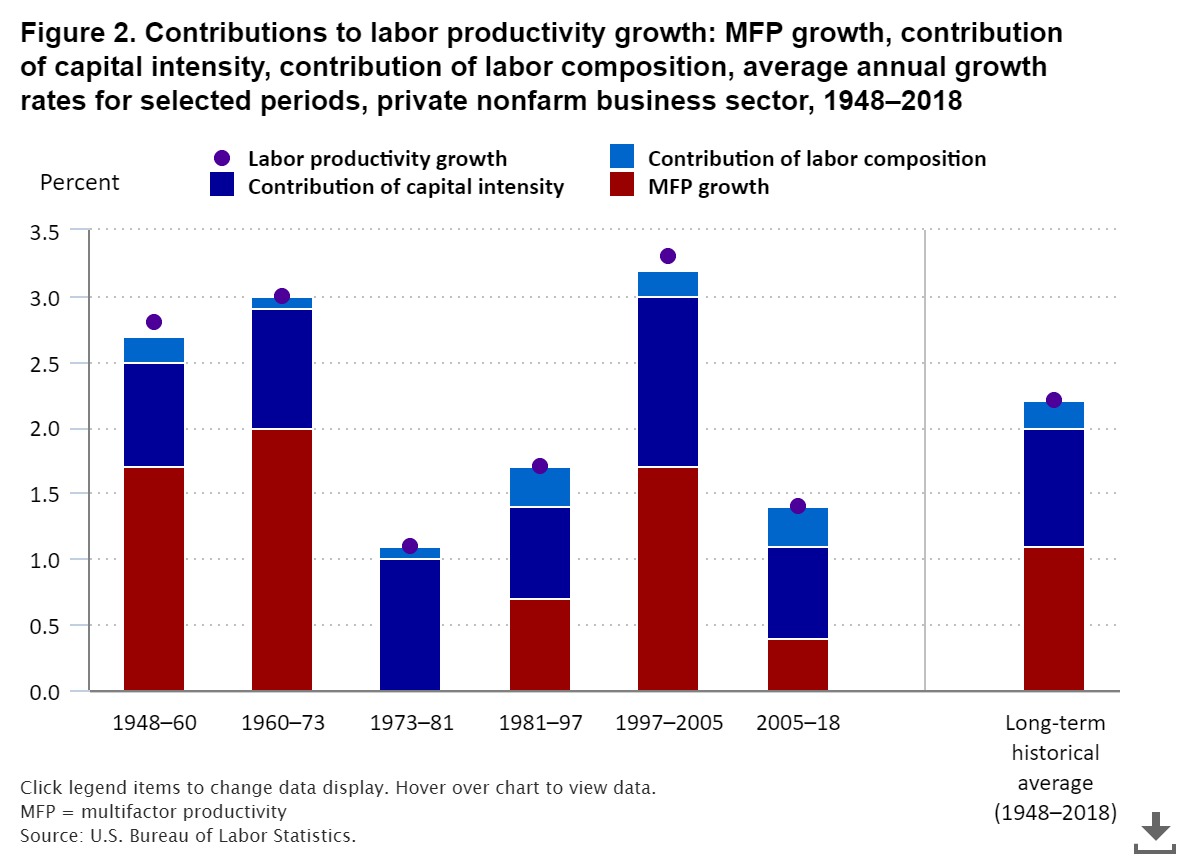
The deceleration in MFP growth—the largest contributor to the slowdown—explains 65 percent of the slowdown relative to the speedup period; it also explains 79 percent of the sluggishness relative to the long-term historical average rate. The massive deceleration in MFP growth is also emblematic of a broader phenomenon shown in figure 2. We can see that throughout the historical period since WWII, the majority of the variation in labor productivity growth from one period to the next was from underlying variation in MFP growth, rather than from the other two components.
However, the most recent slowdown in productivity also seems to have something to do with capital investment. Sprague again:
At the same time, in addition to the notable variation in MFP growth during the recent periods, something unprecedented about these recent periods was the additional contribution from variation in the contribution of capital intensity. The contribution of capital intensity had previously remained within a relatively small range (0.7 percent to 1.0 percent) during the first five decades of post-WWII periods, but then in the 1997–2005 period, the measure nearly doubled, from 0.7 percent up to 1.3 percent, followed by nearly halving to 0.7 percent in the 2005–18 period. … The contribution of capital intensity accounts for 34 percent of the labor productivity slowdown relative to the speedup period and explains 25 percent of the sluggishness relative to the long-term historical average rate.
One underlying rationale for this potential story is provided by Joseph A. Tainter. This author offers that, in general, as complexity in a society increases following initial waves of innovation, further innovations become increasingly costly because of diminishing returns. As a result, productivity growth eventually succumbs and recedes below its once torrid pace: “As easier questions are resolved, science moves inevitably to more complex research areas and to larger, costlier organizations,” clarifying that “exponential growth in the size and costliness of science, in fact, is necessary simply to maintain a constant rate of progress.” Nicholas Bloom, Charles I. Jones, John Van Reenen, and Michael Webb offer supporting evidence for this view regarding the United States, asserting that given that the number of researchers has risen exponentially over the last century—increasing by 23 times since 1930—it is apparent that producing innovations has become substantially more costly during this period.

This selection of industries may feel counterintuitive, but remember that this is a comparison between two time periods. Thus, the figure isn\’t saying that productivity outright declined in these sectors–only that the gain after 2005 was slower than the gain in the pre-2005 decade. In computers, for example, rate of decline in prices of microprocessors began to slow down in the mid-2000s. Similarly, retail and wholesale businesses underwent a huge change in the late 1990s and early 2000s that increased their productivity, but then the changes after that time were more modest. In short, this is the detailed version industry-level version of the argument that the productivity rise from 1997-2005 was a one-time blip.
Again, this thesis has some plausibility. One never wants to fall into the trap of thinking that output as measured by GDP is also a measure of social welfare. It\’s well-known that GDP measures money spent on health care and money spent on environmental protection, but will have troubles measuring gains in actual health or the environment. GDP will often have a hard time measuring gains in variety and flexibility as well.


