US Holders of Foreign Assets, Foreign Holders of US Assets, and Exorbitant Privilege

US investors put money in assets of other countries, including “portfolio investment” which focuses on ownership of stocks and bonds without a management interest, and “foreign direct investment” which is owning enough of a foreign company to have a management interest. Conversely, foreign investors put money into US dollar assets in the US economy. Erin Whitaker and Tiffany Dang of the US Bureau of Economic Analysis put togethere the most recent data in “A Look at the U.S. International Investment Position: Fourth Quarter and Year 2024” (Survey of Current Business, April 7, 2025).

Here’s the overall picture. Just to be clear, “U.S. Assets” does not mean assets owned by the US government, but instead is the foreign assets owned by all US firms and individuals. Conversely, “U.S. Liabilities” does not mean that this is a debt owed by the US government. Instead, it is the sum of the assets that what foreign investors–private and public–own across the US economy. Also, notice that the vertical axis here is being measured in trillions of dollars: for perspective, total US GDP in 2025 will be about $28 trillion. We are talking about substantial amounts here. The gap between US assets and US liabilities was about $7 trillion back in 2015, but is now about $26 trillion.

Clearly, US liabilities exceed US assets, and the gap is growing. What are the implications of that fact in practice? To get a grip on these issues, first look at a breakdown of these assets and liabilities: first the US ownership of foriegn assets and then the foreign ownership of US assets.
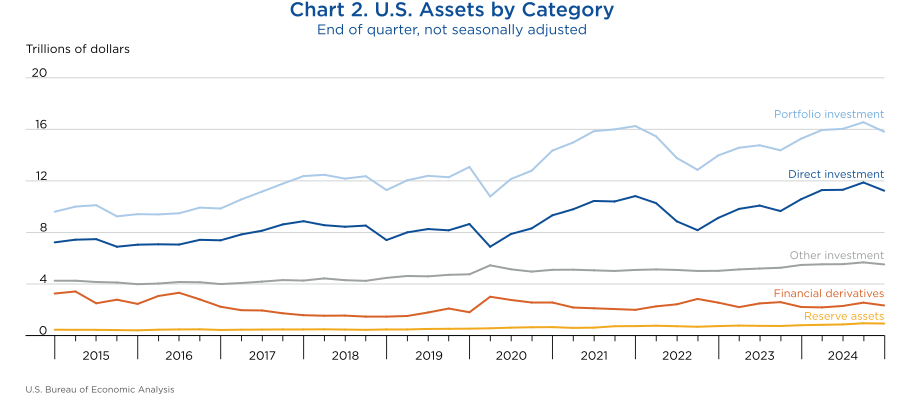
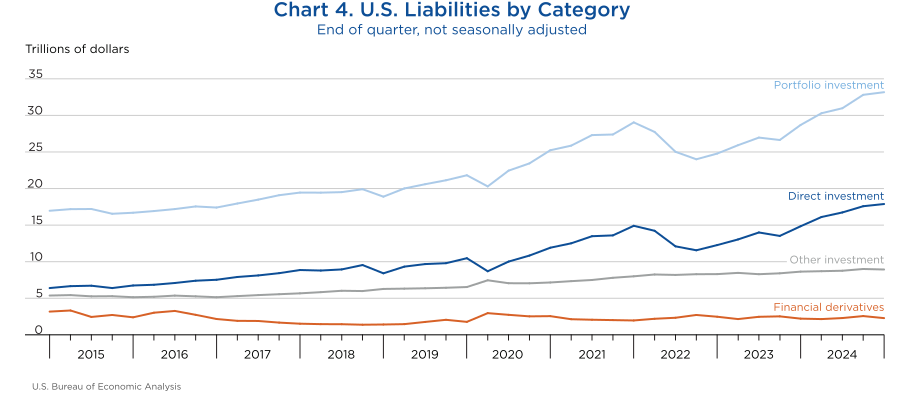
Chart 2. U.S. Assets by Category.
Chart 4. U.S. Liabilities by Category.

There are several ways that these totals for assets and liabilities can change over time. If the US stock market goes up, for example, then the assets of foreign investors in the US stock market also rise in value. Indeed, the primary reason why “US Liabilities” have risen so sharply, and why the gap between US assets and liabilities has increased so much, is that the US stock market has been rising much faster than foreign stock markets, and the value of holdings of US assets by foreign investors has risen accordingly.

Other factors make a difference as well. All the figures here are expressed in dollars, so in figuring out that the foreign investments of US investors are worth, there has been an exchange rate conversion–and shifts in exchange rates will affect the total US assets.

In some cases, assets owned in another country involve a near-term financial payments; for example, if a foreign investor owns US Treasury bonds, the investor will be paid interest on those bonds. However, if a foreign investor owns stock in a US company that doesn’t pay dividends, the value of that stock can rise and fall without causing a need for a payment to that foreign investor.

I’ll focus here on the returns on direct investments and portfolio investments. As you’ll US investors holding foreign assets have typically earned higher rates of return than foreign investors holding US assets–a situation that the research literature calls “exorbitant privilege.”

Here’s a figure showing the return on direct investments over time, from a different Bureau of Economic Analysis report. The bars show the amounts paid in billions of dollars, as measured on the left-hand axis, while the lines show the rate of return, measured on the right-hand axis. Clearly, what US investors are receiving from direct investments abroad is higher than what foreign investors are receiving.
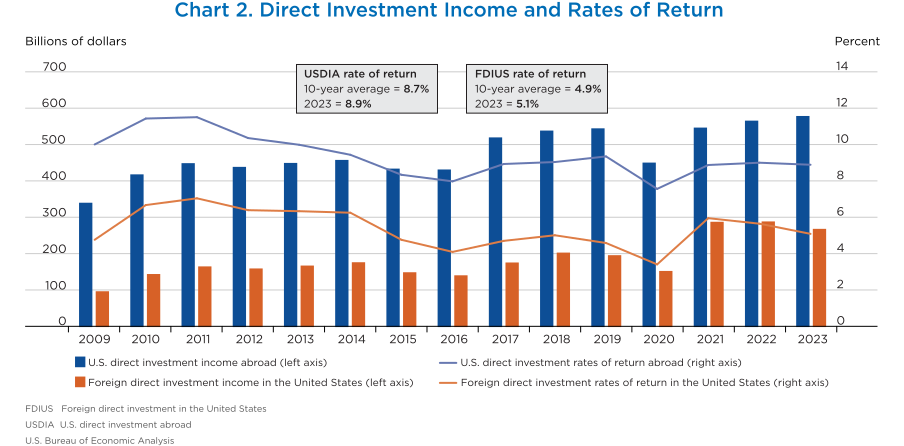
Chart 2. Direct Investment Income and Rates of Return. Bar and Line Chart.

What about the US return on foreign portfolio investments, and converse, the foreign return on US portfolio investments? Carol C. Bertaut, Stephanie E. Curcuru, Ester Faia, Pierre-Olivier Gourinchas offer new measures of “New Evidence on the US Excess Return on Foreign Portfolios” in a Federal Reserve discussion paper (Number 1398, November 2024). Lookign at data from 2005-2022, they write:

Portfolio returns play an important role in global wealth dynamics. A key stylized fact, first established by Gourinchas and Rey (2007a), is that the return on US external claims consistently exceeds that on US external liabilities, the so-called ‘exorbitant privilege.’ A positive excess return helps to stabilize the US external asset position and makes US current account deficits more sustainable … Our first finding is that the US excess return on portfolio (equity and bond) assets averages a modest 0.5% per year over the full sample. It is significantly higher, averaging 1.7% per year, when we exclude the pandemic period (2020-22).

Looking at the figures above, the foreign portfolio investment in US assets is about $17 trillion higher than US portfolio investment in foreign assets. Using the over-time average of 0.5% per year, US investors would be receiving about $85 billion more each year from their portfolio investments than foreign investors are receiving from their US portfolio investments. If one excludes the pandemic and uses the more common 1.7% difference, the gap in portfolio-related gains would be $289 billion per year.

The fundamental reason why US investors in foreign countries are receiving higher returns is that they are willing to take on more risk. To oversimplify significantly, you can imagine foreign investors putting money into bonds issued by the US Treasury and by big corporation, while US investors are more likely to be seeking out investment with both greater risk and opportunities for growth.

These figures suggest some reorientation of how one thinks about “international trade. As yet another Bureau of Economic Analysis press release reports (February 5, 2025), the US economy had a trade deficit in goods of $1,211 billion in 2024. This number has been the focus of the tariffs that President Trump has announced. However, the US economy runs a trade surplus in trade of services, totalling $293 billion in 2024. (Although the US trade deficit in goods is taken, at least in White House political circles, to be full proof of unfair trade barriers by other countries against US exported goods, the US trade surplus in services, by contrast, has no implications at all as to whether the US is imposing unfair trade barriers in services with regard to US imported goods. Go figure.)

Moreover, payments across borders as a result of direct and portfolio investment also favor the US by several hundred billion dollars. Moreover, I should emphasize that a variety of other payments go into what is called the “current account balance,” the broadest measure that combines international payments related to trade in good and services, as well as foriegn investments, and also includes remittances that immigrants send to their home countries, payments made by foreign insurance companies, payments between governments, and other categories. For those who want the full account of the current account balance, a baseline starting point is “U.S. International Transactions, 4th Quarter and Year 2024.”

How much should Americans worry about the large and growing gap between US assets and US liabilities? Looking back about 20 years, the gap–that is, the “net foreign asset position”–was much smaller: back around 2005, the gap was about 15% of US GDP, while now it’s more than 90% of US GDP. Twenty years ago, the gap was much smaller, so that that when the net foreign asset position became somewhat larger and more negative in a given year, this change was fully offset by the higher returns being earned by US investors holding foreign assets. This was “exorbitant privilege.”

But now, thanks mostly to foreign ownership of US assets and the very strong rise in US stock markets, the net foreign asset position has become enormously more negative at $28 trillion. The rate of return earned by US investors with foreign assets continues to exceed that of foreign investors holding US assets, but that $28 trillion gap is so large that the additional payments received by US investors in a given year no longer cover the increasingly negative net foreign asset position. Thus, Andrew Atkeson, Jonathan Heathcote and Fabrizio Perri have a research paper forthcoming in the American Economic Review called “The End of Privilege: A Reexamination of the Net Foreign Asset Position of the United States.

As Atkeson, Heathcote, and Perri point out, this fact may alter how you think about the large gains in US stock markets. If US stocks are primarily owned by US citizens, then gains in the US stock market redound to the benefit of Americans. But the rising foreign ownership of US stock markets suggests that gains in US stocks are increasing flowing to foreign investors, instead. International diversification of investments has both gains and tradeoffs.

Interview with Kenneth Rogoff: Prospects for Debt and Inflation

Tyler Cowen has one of his characteristically wide-ranging “Conversations With Tyler” with “Kenneth Rogoff on Monetary Moves, Fiscal Gambits, and Classical Chess” (April 30, 2025, audio and transcript available). Here, I’ll pass over the comments about the economies of China, Pakistan, Latin America, Japan, the EU, and Argentina, and focus on Rogoff’s comments on the prospects for US debt and for a surge of inflation in the medium-term:

Looking way forward, I would just say we’re on an unsustainable path [for federal givernemtn borrowing]. We will continue to have our debt balloon. Eventually — not necessarily in a planned or coherent way — I think we’re going to have another big inflation soon, next five to seven years, maybe sooner with what’s going on, and that’s going to bring it down just like it did under Biden. It brought the debt down. Then the markets are, fool me once, shame on you. Fool me twice, no, we’re raising the interest rate, and then we’ll have to make choices. …

Last time [during the Biden administration] we probably had a bonus 10 percent inflation over the 2 percent target cumulatively, maybe 12 percent. I think this time, it’ll be more on the order of cumulatively over the 2 percent target, 20 percent, 25 percent. There’s going to be an adjustment. I don’t think the debt is going to be the sole contribution to that. There are many factors. You have to impinge on Federal Reserve independence. Probably, there’ll be some shock, which will justify it. I don’t know how it’s going to play out.

I know that for years, people have said the US debt is unsustainable, but it hasn’t come to roost because we’ve lived through this post-financial crisis, post-pandemic era of very, very low and negative real interest rates. That is not the norm. There’s regression to mean. You know what? It’s happened. Suddenly, the interest payments start piling up. I think they’ve at least doubled over the last few years. They’re quickly on their way to tripling, of going up to $1 trillion. Suddenly, it’s more than our defense spending. That’s the most important macro change in the world, that real interest rates appear to have regressed more towards long-term trend. …

The problem is in our politics. It’s in our DNA. We’re convinced that we’re immortals, and we can just do whatever we want. You go around Washington, whatever they say, I think that’s what they think. Again, this key thing is that real interest rates, the interest rate adjusted for expected inflation — and I’m looking at the long term — they’ve come up. They’re not super high, but they’re more like they were in the early 2000s, and, I think, of reasonable projections, they’re going to stay around the level they are now. …

My students, for a long time, just didn’t believe there’d ever be inflation again. I would teach it; they would fall asleep. I remember asking a question even to someone who was a research assistant at a big central bank, “Explain this to me about inflation.” She said, “My generation doesn’t ever expect to think about inflation. We don’t have it. Please give examples of this.” So no, I would suspect we will have high real interest rate.

What if the Good Samaritan Had Been in a Hurry?

In his new book on how to reduce gun violence, Jens Ludwig tells the story of a classic social science Good Samaritan experiment (the book is Uuforgiving Places: The Unexpected Origins of American Gun Violence).

In a canonical study from the 1970s, a team of social psychologists enrolled forty students from the Princeton Theological Seminary and asked them to walk across campus to another university building to deliver a talk on the parable of the Good Samaritan. In the biblical story, a man is robbed and left injured at the side of the road; he is then ignored by a passing priest before being cared for by a passing good Samaritan. In the study, the subjects encountered a person (a plant of the researchers) slumped in a doorway, not moving, eyes closed, who would cough and groan as the subject went by—a person, in other words, in need of help. Yet only 40 percent of the seminary students stopped to help the person in need. As the researchers observed, “On several occasions, a seminary student going to give a talk on the parable of the Good Samaritan literally stepped over the victim as he hurried on his way.”

What distinguished the subjects who helped from those who didn’t? Was it something about their character, like their level of religious devotion? It turns out that how religious subjects were explained little about who stopped to help and who didn’t. The most important factor? Whether the subject was in a hurry. Some were randomly assigned to be told they were late to give their talk, while others weren’t. Those who were in a hurry helped far less (10 percent) than those not in a hurry (63 percent). The lesson of the Bad Samaritan is not so much about the effects of hurrying per se. It’s more general: For helping behavior, the situation mattered far more than the person.

Many of us live large portions of our days in a hurry. But people in a hurry are often distracted, to the extent of not reacting to what’s in front of them in the way that they would actually prefer–that is, if people act (or don’t act) in they way they would have preferred if they weren’t in a hurry. The long-ago famous UCLA basketball coach John Wooden is quoted as saying: “Be quick, but don’t hurry.”

Ludwig’s theme about gun violence is that something like 80% of gun violence is not about immediate financial gain, as in a robbery, nor about psychopaths and assassinations, as in the movies, but instead is about a situation where an argument erupts between two people. Ludwig argues that there is often a short window of time when the argument escalates past a critical point into violence. If we can find ways to make the escalation less likely, or to interrupt that (say) 10-minute window, we can reduce the likelihood of one person dying and another person ending up in prison. The solution is often less about confrontation than it is about distraction–so that people who are walking down a tunnel of rage, or close to doing so, can divert to a different path. Ludwig makes no claim that this is a full or complete solution to gun violence, but only that there is considerable evidence from urban design and violence prevention programs that demonstrate real gains.

Ludwig is of course aware that this prescription won’t satisfy those who think the solution to gun violence involves laws and rules to restrict gun use, nor those who believe that a policy of more severe punishments for shooters will cause people in the midst of white-hot anger to think carefully and back away. He writes: “If, for better or worse, the four hundred million firearms in the US aren’t just going to disappear anytime soon, if major nationwide gun control is unlikely in the foreseeable future, then progress on gun violence can—or maybe must—come from figuring out how to reduce the tendency of people to use those widely available guns to harm one another.”

For some previous posts on the lack of evidence for what policies are likely to reduce gun violence, see here and here. For those who want to know more about the Good Samaritan study, the citation is Darley, John M., and C. Daniel Batson. “‘From Jerusalem to Jericho’: A Study of Situational and Dispositional Variables in Helping Behavior.” Journal of Personality and Social Psychology 27, no. 1 (1973): 100–108.

A Primer on the Economic Effects of Tariffs

If you are looking for a fairly easy read that describes how economists view the effects of tariffs, you could do worse thatn start with tbhe overview essay by Kyle Pomerleau and Erica York, “Understanding the Effects of Tariffs” (American Enterprise Institute, April 2025). Here, I’ll skip past their historical discussions of US tariffs, and President Trump’s historical affinity for tariffs, and just summarize some bottom lines–with more details available in the paper itself:

Will tariffs reduce the US trade deficit?

Although it may seem intuitive that taxing imports would reduce net imports, tariffs do not have a direct impact on the balance of trade. The trade balance is driven by net lending and borrowing between the United States and the rest of the world. Instead of reducing net imports, tariffs simply reduce overall trade. … Tariffs cannot permanently change the trade balance. Tariffs that reduce imports result in an equivalent reduction in exports in present discounted value, reducing overall trade but not the trade deficit.

How will tariffs affect the US dollar exchange rate?

Tariffs have a direct impact on the value of the USD [US dollar] by changing its supply (or the demand for foreign currency). When a tariff is enacted, it results in reduced US demand for imported goods. Since foreign exporters receive dollars for goods sold to Americans, a reduction in US demand for imported goods would reduce the supply of USD in the world market, resulting in an appreciation of the USD relative to other currencies. … [T]he stronger dollar would have an immediate negative impact on exports. Foreigners would find it more expensive to purchase US goods and services because foreigners earn incomes in their domestic currency and need to convert it to the more expensive USD to purchase US goods. … Finally, the appreciation of the USD due to enactment of a tariff would result in a onetime transfer of wealth from Americans to foreigners. A onetime appreciation of the USD would mean that the USD value of foreign assets would fall because it would become more expensive to convert foreign currencies into USD. At the same time, the stronger USD would be more favorable to foreigners, who could now receive a higher return in their domestic currency for a fixed amount of wealth denominated in USD.

How will tariffs affect the price level, and thus affect the real value of wages?

Intuition suggests that tariffs, like other excise taxes on products, should raise prices. While such taxes may raise the price of the taxed goods, the general price level is ultimately determined by the Federal Reserve’s actions. The Federal Reserve, which has a mandate for both price stability and employment, would likely increase the
price level in response to tariffs, but only if the tariff increase were significant. … Note that accommodation by the Federal Reserve results in a onetime adjustment to the price level, not a persistent increase in the rate of inflation. It is worth emphasizing that whether the Federal Reserve accommodates the tariff, it burdens households in the form of lower real, after-tax income. With accommodation, nominal incomes remain fixed while nominal prices rise, resulting in falling real incomes. Without accommodation, nominal incomes fall while nominal prices remain fixed, also resulting in falling real incomes.

Tariffs and the likelihood of retaliation

Trade is a two-sided transaction that benefits both buyers and sellers. The taxes that the United States imposes on foreign goods have a negative impact on the US economy and its trading partners’ economies. Likewise, the taxes foreign countries place on US exports harm both the foreign country imposing the tariffs and the United States. A foreign tariff can reduce demand in a foreign jurisdiction for US goods, reducing income earned by affected US exporters. … In 2018 and 2019, jurisdictions including China, the European Union, Japan, Russia, and the United Kingdom responded to US tariffs by imposing tariffs on US exports, affecting approximately 8.7 percent of 2017 exports (Williams and Hammond 2020). The US Department of Agriculture estimated that in 2018 and 2019, direct US agricultural export losses totaled more than $27 billion (Morgan et al. 2022). Retaliation created an additional drag on US output in the manufacturing sector, which, combined with the effects of higher input costs from tariffs, offset the benefits of protection for the sector (Flaaen and Pierce 2024).

A 10% tariff on goods might plausibly raise about $200 billion per year in tax revenue for the government. For comparison, federal revenue from the individual income tax is more than 10 times as high, at about $2.3 trillion per year.

Consider a proposal to enact a 10 percent across-the-board tariff on imported goods. Actual goods imports totaled $3.3 trillion in 2024 (BEA n.d.) … The taxable base would be smaller after considering noncompliance and behavioral responses. We assume noncompliance of 15 percent, which is consistent with the average across all taxes and the noncompliance rate assumed by the Tax Policy Center when it estimates the revenue effects of a value-added tax (Toder et al. 2011). In addition, we assume an elasticity of −0.76 in the first year that grows to −2 by 2032. … Applying the Joint Committee on Taxation’s latest income and payroll tax offset, which suggests that 26.2 percent of gross tariff revenue over the next decade will be offset through reductions in income and payroll taxes, the 10 percent across-the-board tariff is projected to raise $1.95 trillion over the next decade on a conventional basis …

Pomerleau and York are almost visibly striving for an even-handed tone, which of course endears them to me. But I’ll note that as a result they do not emphasize what seem to me some of the ways in which tariffs can severely injure US manufacturing firms: by taxing the imported inputs that US manufacturing firms need for production, and by the likelihood that US manufacturing firms will lose export markets as other countries retaliate with tariffs of their own.

Interview with Robert Barro: Empirical Macroeconomics

Jon Hartley serves as interlocutor in “Revisiting Empirical Macroeconomics with Robert Barro” (Hoover Institution, Capitalism and Freedom Podcast, March 25, 2025, audio and transcript available). Here are a few of the comments from Barro that especially caught my eye.

One basic question in economics is about “the multiplier”–that is, how much will an increase in government spending boost the size of the economy. If the boost in government spending doesn’t increase the size of the economy, the multiplier is zero. If it raises the size of the economy one-for-one, then the multiplier is one. Optimists about governmetn spending sometimes claim the multipler is more than one, while pessimists hold that it might be negative. Barro argues that, at least in most settings, the evidence supports a multiplier between zero and one. Barro says:

Looking at the variations in military spending in the US context over a fairly long time period is a very good setting for trying to isolate spending multipliers associated with basically exogenous movements in the amount of government expenditure. You wouldn’t do this for many countries during wartime because the direct destructive effects of wartime tend to be dominant. And typically in wartime you would estimate negative spending multipliers associated with military outlays. But the US is different in that respect. It doesn’t have that kind of massive destruction associated, particularly with World War II.

So it was a very good setting, I think, for looking to isolate the effect of these exogenous and large spending changes. So the multipliers were positive. I mean, the right baseline is 0, not 1. If the multiplier is 1, it means you’re basically getting as much output as you’re using up, which makes it sound like it’s a free thing … But the right benchmark is a multiplier of zero because that means that in order to get the extra spending let’s say for military, you have to cut back on other spending one for one. …

So we found multipliers that were more like a half or something, which means that you have to pay for 50% of the extra. So it’s a multiplier of one and above is kind of completely ridiculous. I mean, a multiplier above one means you’re not only getting the military spending for free, you’re getting something extra for coming from nowhere. It should be a very surprising result to have multipliers that are above one. And you certainly wouldn’t find that in normal times or in some kind of long run setting. 

Inflation reduces the value of existing debt. Thus, if government spending leads to an increase in inflation–and thus reduces the value of existing government debt–there is a sense in which the government used inflation to “pay for” its spending increase. Here’s Barro:

So if you have a massive increase [in government spending], such as the transfer payments, even more under Biden than under the first Trump administration, a way to avoid paying for that by cutting other spending or by raising taxes is by having a inflation that’s surprising from a perspective of a pre crisis period. And that basically wipes out a lot of real value of the government bonds that are outstanding and it amounts to a very large temporary source of revenue which can be something like 10, 15% of the GDP. So it’s not a minor deal. And that’s empirically about what happened in the US and also in other places. …

[P]eople don’t like the idea that it might not have been completely crazy to pay for the expenditure in substantial part through this surprise inflation. I get a lot of grief on that point from people who normally, who normally are on my side about things because they just want to think of the inflation as being stupid and being dramatically harmful. So I think what was harmful is the excessive fiscal expansion, particularly under Biden. It was unnecessary to have that vast increase in transfer payments, but given that you had it, we effectively paid for most of it through the surprise inflation. And maybe that part was not so crazy because the alternatives would have been also very costly.

Back in the 20th century, it was common to study causes of economic growth by looking a patterns across countries. However, these studies were inevitably about correlations, not necessarily causation. Thus, a lot of economic research has now shifted to looking for experiments–either designed or “natural” in some way–where causation is more clear. Barro argues that for broad topics of economic growth, cross-country regressions should continue to be viewed as a productive approach.

if you want to think about what matters for growth and, and how it depends on policies and things like property rights and fertility behavior and education and all those, the natural empirical arena to consider there is the cross country experiences where you have a lot of variety in terms of different policies and institutions being put into place and you have some hope from that of trying to isolate what things matter for long run economic growth. And that was the work I particularly put my efforts into in the 1990s going into the 2000s. And for a while there was a tremendous interest in that work and it was probably the most cited part of economics overall. But then you had this kind of so called credibility revolution in econometrics and identification and it was clear that to be using this cross country context leads to a lot of issues where you don’t get perfect identification.

There are some legitimate problems that arise in terms of various things being endogenous and too many things potentially mattering. But then I don’t understand how the outcome from that is supposed to be. Then you ignore the best data that you have that pertain to these questions. What which is this cross country experience, you almost never have experiences in terms of macroeconomics and growth where you have the kinds of exogenous experiments or near experiments that you would want to get clean identification. And then I think it’s really unfortunate that what can be gleaned from the data that are available with the possible identification methods and implementations and then ignoring that I think is a great mistake. But that’s the situation we’re in now. It’s basically you just can’t do that kind of work now. It’s viewed as not legitimate. And I think that that’s really wrong and unfortunate.

The Silver (-Haired) Economy

In its most recent World Economic Outlook report, the IMF includes a chapter on “The Rise of the Silver Economy: Global Implications of Population Aging” (April 2025).

Here are the big trends in a nutshell. The red line (measured on the right-hand axis) shows that the average age of the global poulation was about 27 years back in 1980, is now up to about 35 years ,and is headed above 40 years in a few decades. The blue line shows average annual population growth. From 1980 to the present, it fell from 1.8% to about 0.8%, and it’s headed toward negative population growth later this century.

Of cousre, this decline in population growth isn’t distributed equally. This figure shows the timing at which countries start to experience a decline in the “working-age” population, defined here as ages 15-64. As you can see, Germany, France, Italy, and Japan were already experiencing a declin in the working-age population before the year 2000. Since 2000, the US, Canada, China, Korea, and Brazil have joined the club. In the 2030s, India and Indonesia will start to experience a declining working-age population. By later in the century, the pattern is projected to reach countries across Africa, like Nigeria, Ethiopia, Kenya, Ghana, and others.

Does a decline in working-age population necessarily mean a corresponding decline in economic output? Maybe not. There will be more workers with greater experience. In addition, people seem to be maintaining their cognitive sharpness and physical health later in life, which is not only a good thing in and of itself, but also increases the chance that they will continue contributing to the economy as workers for a few years longer. The IMF rreport notes:

Alongside increases in longevity, the functional capacity of older individuals has improved over time. More recent cohorts of older individuals are physically stronger and cognitively abler than earlier cohorts at the same age. Notably, when cognitive capacities are the focus, “the 70s are the new 50s”: Data from a sample of 41 advanced and emerging market economies indicate that, on average, a person who was 70 in 2022 had the same cognitive ability as a 53-yearold in 2000. Over the course of a decade, this pace of improvement in cognitive abilities is associated with an increase of approximately 20 percentage points in the likelihood that individuals remain engaged in the labor market, either by working or actively seeking employment, along with an increase of about six hours in average weekly hours worked and a 30 percent rise in labor earnings, conditional on being employed.

Ultimately,the ability of economies to adjust to these demographic shifts will rely on a few variables: Is there at least a moderate upward trend in the number of people who continue working after age 65? Are people saving more, so that they will be ready for longer retirement? Will the skills of experienced older workers perhaps be an especially good complement with emerging AI tools, thus allowing them to maintain high productivity for longer? Are people planning for old age without too heavy a reliance on support from the smaller younger generations of their families? Is the private sector making the kind of investments in technology and physical capital that can raise the productivity of older workers? Will the public sector adjust old-age pensions to keep them solvent? Is a combination of the private and public sector making the kinds of investments so that homes, public spaces, and care facilities are available and accessible to an older population?

There’s an old line that “everybody talks about the weather, but nobody does anything about it.” One might say something similar about the monumental trend toward global aging. The IMF report sketches out a model of a future where various adjustments in labor force participation, technology, investment, and government policies helps smooth the transition to a “silver economy.” But in many countries, for many people, I suspect it will be a bumpy ride.

A China Problem: When Local Officials Shift from Facilitating Growth to Generating It

China’s economy is an unconventional mixture of central control and subsidies, especially involving the large state-owned firms and the financial sector, mixed with widespread use of privately owned firms and market mechanisms. One common mechanism has been to reward local government officials for meeting the goals that the central government has set for economic growth in their area. This arrangement can work reasonably well–right up to when it doesn’t.

Jeffery (Jinfan) Chang, Yuheng Wang, and Wei Xiong focus on this part of China’s economic story in “Taming Cycles: China’s Growth Targets and Macroeconomic Management” (Brookings Papers on Economic Activity, Spring 2025). Here’s their description of the process of economic goal-setting across levels of China’s government.

From provinces, directly beneath the central government, down to cities, counties, and townships, each level of local government plays a crucial role in translating national targets into concrete economic outcomes. At the start of each year, local governments set their own growth targets in coordination with higher authorities, drawing on assessments of local economic conditions. A notable feature of this process is the phenomenon of “top-down amplification”—whereby national growth targets are consistently exceeded by provincial targets, which in turn are surpassed by city-level targets. This pattern reflects the incentive structure of China’s governance system, where local officials are assessed based on their ability to implement directives from higher authorities and drive economic growth within their jurisdictions. Consequently, regional leaders often set ambitious growth targets that exceed the expectations of their superiors. This strategy serves a dual purpose: providing a buffer to ensure compliance with higher-level expectations while also
motivating subordinates to outperform expectations. In this context, growth targets function not merely as planning tools but as instruments that foster competition among local governments. Our findings reveal a ratchet effect in how local governments adjust their growth targets asymmetrically—raising them aggressively during economic booms but lowering them more cautiously during slowdowns.

This figure illustrates the process in action. The dotted blue line is the national growth rate target. The red solid line is actual growth. The yellow dashed line is the province-level growth target (weighted by economic size of the province) and the green dashed line is the city-level growth target (weighte by economic size of the city).

As the authors point out, it’s useful to think of this figure as in two parts. In the first part, up through about 2010, the target rate for China’s growth is high and the actual growth rate is well above the target. Provinces and cities could set aggressive growth targets accordingly. But after about 2010, the real growth rate drops down to the national target, and the target itself is gradually reduced. The province- and city-level targets also come down, but more slowly.

An unwelcome dynamic emerges here. In the first decade or so of the figure, China’s growth was booming in substantial part as a result of an export surge, following China’s entry into the World Trade Organization in 2001. Lower levels of government could compete with each other to facilitate this growth.

But consider the position of state and local governments as growth rates sag in the second part of the figure. Province- and city-level officials are being held responsible for meeting growth targets, and for them, the idea of proposing lower-level targes for growth is likely to sound dangerous. Many of them will look for ways to prop up the higher growth rates. The province- and city-level governments basically have two sources of funds to do this: land sales and borrowing. Indeed, one reason that China’s growth remained robust during the Great Recession of 2008 was that the central government gave lower levels of government permission to increase their borrowing–and in this way to stimulate their economies. The borrowed money was often used to build infrastructure, not necessarily because the infrastructure was needed, but just because the building itself counted as part of local economic growth for purposes of meeting the targets.

You can see where this is headed. The authors estimate that local-government debt, from 2011-19, grew by an amount equal to 14% of national GDP. The infrastructure that was built during this time was not reflected in greater revenue growth among publicly listed firms (which can be used as a proxy for the underlying economic growth beyond the government debt-induced sugar rush). The authors write:

The disconnect between GDP growth and broader economic indicators may stem from key mechanisms identified in studies of the Chinese economy. As infrastructure investment faced diminishing returns, large-scale projects likely failed to generate meaningful spillover effects (e.g., Qian, Ru, and Xiong, 2024). Meanwhile, the surge in local government debt crowded out capital that could have otherwise supported more productive private enterprises, hindering organic economic growth. This pattern aligns with findings from Cong and others (2019) and Huang, Pagano, and Panizza (2020) on the effects of China’s post-crisis stimulus.

To put it another way, local government officials under competitive pressure across areas to facilitate organic economic growth can be a useful development approach. But local government officials under competitive pressure to substitute for organic economic growth, by using debt to juice the local economy, will tend to leave behind a pile of questionable debt. Meanwhile, China’s official national growth targets were trending down, and how much to trust the official GDP statistics remains a very open question.

Russia: An Unhealthy Population

The welfare of a country’s population goes well beyond economic statistics, of course. In one classic example from 2006, Kevin Murphy and Robert Topel offered an attempt to meaure in economic terms the gains to the US population from greater life expectancy and disease reduction over time. Of course, this task requires choosing values for what an additional year of life is worth in dollar terms–always a controversial task. But the values are extraordinarily large. They wrote:

We estimate the economic gains from declining mortality in the United States over the twentieth century, and we value the prospective gains that could be obtained from further progress against major diseases. These values are enormous. Gains in life expectancy over the century were worth over $1.2 million per person to the current population. From 1970 to 2000, gains in life expectancy added about $3.2 trillion per year to national wealth, with half of these gains due to progress against heart disease alone. Looking ahead, we estimate that even modest progress against major diseases would be extremely valuable. For example, a permanent 1 percent reduction in mortality from cancer has a present value to current and future generations of Americans of nearly $500 billion, whereas a cure (if one is feasible) would be worth about $50 trillion.

Russia illustrates the opposite situation. It’s health statistics are remarkably poor, suggesting that the overall welfare of Russia’s population is considerably worse than its purely economic statistics would suggest. Nicholas Eberstadt provides the background in “The Russian Paradox: So Much Education, So Little Human Capital” (The American Enterprise, April 8, 2025).

Eberstadt first described Russia’s education and per capita GDP levels in the context of European countries. As the figure shows, Russia’s per capita GDP (horizontal axis) put it near the bottom of the range for European countries, but its education levels (vertical axis) are fairly close to a number of European countries.

But while life expectancies around the world have generally been rising, Russia’s life expectancies have not risen for about a half-century. As a result, Russia ranks with many of the world’s lesser developed countries in life expectancy–in this graph, between Haiti and Benin, well behind Bangladesh, Ethiopia, Rwanda, and others.

How is this possible? One place to start looking for an answer is in the causes of death. This figure shows cardiovascular death rates on the horizontal axis, and “injury” death rates on the vertical axis, where “injury” includes homicide, suicide, poisoning, and “accidents.” The points represent countries of Europe, with the orange point showing the average for all OECD countries (basically, the high-income countries of the world). Russia is clearly the outlier.

I will leave speculating about specific reasons why health in Russia might be so poor to you, gentle reader. I will only note that such miserable health statistics, given the economic and education patterns in Russia, suggest deep level of dysfunctionality and weakness in Russian society.

Poland’s Economy Flexes

The economy of Poland has done very well in the last couple of decades, especially in comparison to other countries of eastern Europe that escaped from Soviet political and economic control back in the 1990s. The IMF does semi-regular reviews of national economies in what are called “Article IV” report. Here are some insights from the IMF on Poland’s economy (Republic of Poland — 2024 Arcticle IV Consultation, January 2025).

Poland has achieved substantial economic convergence within the EU. The economy has roughly doubled in size over the last two decades. Real GDP per capita over the same period has increased from just under 50 percent of the EU27 average to 80 percent. Growth has been among the fastest historically for an economy of its income level and size, now the 20th largest in the world in real terms. Social indicators have also improved markedly with strong education outcomes and declining poverty rates. Moreover, income inequality in Poland is among the lowest in the OECD.

One issue for countries like Poland is the dreaded “middle-income trap,” where an economy goes through a pattern of productivity growth and corresponding structural change for a time, but then its rapid growth levels off. However, Poland seems to be proceeding along the path of South Korea, a country which has suffered less from the middle-income trap than many others.

The horizontal axis on the figure measures from the date in which a national economy reached a per capita GDP of $25,000. As you can seem, Korea (blue dashed line) kept growing strongly and Poland (red solid line) has done the same, while countries like Spain and Hungary have seen their growth rates drop off. You should get used to thinking of Poland’s growth experience as similar to that of Korea.

While Poland’s economy has grown, its rates of poverty have fallen (not especially surprising) and also its rates of inequality (somewhat surprising). While greater economic growth and greater inequality do sometimes go together, the connection between the two is heavily shaped by political decisions.

There are now predictions that next year, per capita GDP in Poland will surpass that of Japan. So along with thinking of Poland’s growth experience as similar to that of Korea, you need to get used to thinking of the average standard of living in Poland as similar to that of Japan.

One reservation about these comparisons is worth noting. To compare GDP between countries that use different currencies, one has to choose an exchange rate. There are basically two choices here: a market exchange rate, which will then fluctuate with the sometimes volatile global exchange rate markets, or an exchange rate that is calculated based on the buying power of a currency as measured in internationally tradeable goods. This second approach is called a “purchasing power parity” exchange rate, which is calculated by a research group at the World Bank. (For an overview of their most recent report, see here.)

The choice between market exchange rates and PPP exchange rates can make a big difference in international comparisons. For example, if one compares the GDP of the United States and China using market exchange rates, the US GDP is about 50% bigger than China. But if you do the same comparison using PPP exchange rates, then China’s economy is about 25% larger than the US.

In general, the PPP exchange rate takes into effect the fact that many goods and services are considerably cheaper in lower-income countries. Thus, the buying power of currencies within that country is larger. A rule-of-thumb is that when comparing average standard of living between countries, per capita GDP converted at the PPP exchange rate makes sense. But when looking at global economic clout, the market exchange rate remains highly relevant.

Getting back to Poland, no country has a guarantee of future economic success, and the IMF report discusses a number of potential bumps for Poland in the economic road ahead. But it’s worth noting that back in the 1990s, when countries across eastern Europe were coming out from under Soviet control, Poland was known as a country that followed a disruptive “shock therapy” approach to its economic transition to a market-oriented economy, as opposed to other countries that sought to follow a more staged and nuanced step-by-step approach. For Poland, the embrace of market economics has paid off.

Tax Privacy

In an era where many people are highly sensitive to what personal information is being collected about them, and how that information is being used, one sometimes hear the question: Why should the government have any power to know your income? In a US context, the question is often asked around April 15, when income tax returns are due.

Also in a US context, the answer to why the federal government has power to know your income is straightforward: It’s in the US constitution. Specifically, the Sixteenth Amendment ratified in 1913 reads: “The Congress shall have power to lay and collect taxes on incomes, from whatever source derived, without apportionment among the several States, and without regard to any census or enumeration.” Before the amendment was passed, US Supreme Court in 1895 had struck down a federal income tax passed the previous year in the case of Pollock v. Farmers’ Loan & Trust Co.

But privacy can be expressed at different levels. The US government can require you to report your income, but your personal tax returns are supposed to be confidential. Joel Slemrod discusses “Tax Privacy” in the Winter 2025 issue of the Journal of Economic Perspectives (where I work as Managing Editor). Slemrod writes:

In several countries, at least some information from income tax returns of both individuals and companies is made available to the public as a policy choice. Public access to corporate tax information is provided in Australia, Iceland, Finland, Norway, Pakistan, and Sweden, and was once the law in Japan. Personal-level public disclosure is available on the internet in Norway, whereas Sweden, Finland and Iceland have systems where one can apply to the tax authorities for information about individuals, in Iceland for only a very limited time period. Pakistan introduced public disclosure for both corporate and personal tax information in 2012. Moreover, the issue is on the policy agenda in several countries, including almost half of the OECD countries. …

Even the United States has had public disclosure of income tax information, if only with occasional and brief experiments. The short-lived Civil War-era income tax provided that the public would be entitled to see the names and tax liabilities of taxpayers. The corporate excise tax of 1909 contained a publicity provision, which was soon after repealed. Information from tax year 1923 income tax returns was publicly released in 1924, although this lasted only to the provision’s repeal in 1926. This episode gave rise to one of the most vivid privacy-related objections to public disclosure. Senator Louis Murphy (D-IA) stated at the time that disclosing income tax data is equivalent to taking “the curtains and shades from the homes of our taxpayers and pull[ing] out the walls of the bathroom to assure that the Peeping Toms shall have full and unobstructed opportunity to feast their eyes on the [tax return]” (as quoted in Leff 1984, pp. 70–71). The Revenue Act of 1934 required all income tax filers to submit a pink-colored form that contained information from the return—name, address, gross income, deductions, taxable income, and tax liability—that would become public. This requirement was, though, abolished before it went fully into effect.

So, would greater public disclosure of income and tax data be a step toward transparency and accountability? Or just give free rein to nosiness and jealousy? Slemrod, writing as an economist, doesn’t seek to address this question directly. But he does point out:

Each November 1, the day the Finnish government publishes citizens’ income and tax payments, is known there as “National Jealousy Day.” Reck, Slemrod, and Vattø (2022) document who searches for whose tax information in Norway, and speculate on the motivations for these searches. Perez-Truglia (2020) argues, using survey data and Norwegian tax records, that the higher wage and salary transparency due to public tax disclosure increases the gap in happiness and life satisfaction between richer and poorer individuals. This finding is reminiscent of Varian’s (2009, p. 8) argument that neighbors may care about the assessment of my house not because they care about my assessment per se, but because they care about their assessment.

Slemrod digs into the trickier questions. When people say that prefer tax privacy, what are they worried about? Government tax enforcement efforts? Romantic interests, spouses, ex-spouses? Co-workers? Difficulties in future economic negotiations over, say, pay in new job, or how much one can afford to donate to an alumi group? A possibility of political or social retaliation? Might we be able to measure greater degrees of privacy or lesser degrees of privacy? For example, perhaps I worry less about my overall income being revealed than I worry about, say, specific charitable contributions being revealed or the size of deductions for medical care.

The value that people place on privacy is notoriously difficult to meaure. Economists measure “value” the value that people place on an object in two ways: what is your willingness-to-pay for an object, and what is your willingness-to-accept for selling the object? For many ordinary goods, these two values will be reasonably similar. But Slemrod points out that when you survey people about how much they would need to be paid for a willingness-to-accept less tax privacy, they tend to give large number, but when you ask them about their willingness-to-pay to protect their tax privacy, they give a much smaller number. To put it another way, people will complain vehemently about invasions of privacy of personal information, but they often don’t bother to take even inexpensive (whether measured in time or money) steps to protect their personal information. that Slemrod writes: “The average willingness-to-accept is 13.5 times larger than the average willingness-to-pay …” One can imagine a tax code that starts off with a list of what personal information you are willing to reveal–or not–but the kicker is that if you reveal less information, you will probably end up paying more in taxes.

When I’m re-reading Jane Austen and other 19th-century novels, I’m sometimes struck by the different attitudes toward financial privacy. In those novels, when a character enters the room, it’s common for other characters to talk about their economic situation: land owned, money “in the funds,” likely inheritances, future jobs, and so on. But characters in those books work hard to avoid talking about personal or romantic feelings. In the modern world, it seems to me that we have inverted this sense of what is private. Many people are quite open about their personal and romantic feelings, positive or negative, in a way that would have been alien to Austen. However, modern people are often quite reticent and find it hard to talk about money, even within the context of family and committed relationships.

This modern desire for economic and tax privacy is somewhat at war with informtion technology. The US economy is moving briskly toward less use of cash, and a number of countries are moving that direction even faster. But when economic transactions are done electronically–whether payrolls or purchases–they leave a record. In that sense, economic privacy is getting harder. If you happen to see my credit-card bills, you would know a great deal about my economic life.