Slavery and Economic Development in Brazil

Roughly half of all the slaves who made the trans-Atlantic passage from Africa to the New World from the 1500s to the 1800s disembarked in Brazil, where slavery was not abolished until 1888. How did slavery affect the economic development of Brazil? Nuno Palma, Andrea Papadia, Thales Pereira, and Leonardo Weller discuss the evidence and research, with occasional contrasts to the US experience of slavery, in “Slavery and Development in Nineteenth Century Brazil” (Capitalism: A Journal of History and Economics, Summer 2021, 2:2, pp. 372-426, subscription or library access needed). They write:

Prior to abolition in 1888, slavery was a pronounced and pervasive feature of Brazil’s economy. More African captives arrived on Brazilian shores than anywhere else in the Americas. From the sixteenth to the nineteenth century, 4.9 million Africans landed in what was a Portuguese colony in the Americas until 1808, an independent joint kingdom with Portugal from 1808 to 1822, and then the Brazilian Empire from 1822 until
the Republic was proclaimed in 1889, the year after emancipation. The total number of
Africans transported to Brazil corresponds to 46 percent of all the enslaved arrivals in the New World and double the number who arrived in the whole of the British Caribbean.
In comparison, the slave trade to the United States was much smaller: only 388,746 slaves disembarked there …

The Brazilian slave trade started in the Northeast of the country during the 1560s. Africans were put to work in the first large-scale sugar plantations of the Americas, … Brazil’s Southeast caught up as a major destination for slaves in the eighteenth century,
during the gold rush in Minas Gerais and other regions. Most Africans entered that region through Rio de Janeiro, which became the largest slave port in the world … A large share of the captives who arrived during the nineteenth century were forced to work in the booming coffee sector, which began in the hinterland of Rio de Janeiro state and subsequently expanded across the plains of São Paulo. The coffee plantations in Rio depended more on slave labor than those in São Paulo, which also employed European migrants, especially
from the 1880s on. An inter-regional slave market grew following the end of the trade with Africa in 1850, after which enslaved people were moved in large numbers from the declining Northeast to the booming Southeast.

Slavery in Brazil was distinctive in a number of ways. For example, it was common for common for slaveowners to have a relatively small number of slaves, like 5-10, rather than slavery being solely focused on large plantations. In addition, slaves were often forced to work in domestic industries, not just in producing a good for export. The authors write of slavery in Brazil:

All sectors depended on slaves. They made up half the sailors in the domestic maritime industry and were also put to work in foreign trade, including in the slave trade itself. Slaves were the backbone of the jerk beef processing industry in the southern state of Rio Grande do Sul. They also worked in whale fishing and processing, mainly in Santa Catarina, Bahia, and Rio de Janeiro. In Minas Gerais, in which the largest slave population in the country was concentrated, most captives produced goods for domestic consumption, such as foods and textiles. … The human capital of slaves is well documented in Minas Gerais, where up
to 30 percent of the captives who worked in construction and textile manufacturing
were specialized laborers such as carpenters or overseers.

In comparing Brazilian slavery in the 19th century to US slavery, one central difference is that even after the United States banned the importation of slaves in 1808, the US slave population increased substantially in the following decades, because the children of slaves were born into slavery themselves. Conversely, Brazil’s slave population decreased during the 19th century. One difference was that the possibilities for slaves to become free were higher in certain areas of Brazil.

Additionally, the [Brazilian] slave population shrank because many were able to gain freedom. Some did so through self-purchase or government programs designed to buy people out of slavery in the decades that preceded emancipation; furthermore, children of free men and slaves were not automatically free but had a good chance of becoming so. As a result, most Brazilians were free but not white: according to the 1872 census, 4.2 million non-white free
people, 1.5 million slaves, and 3.8 million whites lived in the country.

Not only was slavery more prevalent in Brazil than in the United States; it was also a more fluid institution that allowed the enslaved to gain freedom on a larger scale. However, though they were free, former slaves were still at the bottom of society, suffering from persecution and racism. As in the US South, landowners and other local oligarchs actively limited
the outside options of former slaves in order to keep extracting cheap labor from them, often through the use of vagrancy laws. Additionally, poor whites saw free Afro-Brazilians
as competitors for jobs, and elites pushed for racial whitening through immigration from Europe. Often, former slaves performed the same jobs that slaves did, with the benefit of some mobility across the country and without the obligation to pay rents to their masters.

In an American context, one sometimes hears claims that US economic growth of the 19th century was fundamentally based on slavery, and in particular on the interrelationship between slavery and cotton production. Most US economic historians are unpersuaded by these claims. But if the combination of slavery and cotton production was so fundamental to development of the US economy, why didn’t it do more to help 19th-century economic development in Brazil?

As the authors discuss, large-scale cotton production and cotton exports to Great Britain were already firmly established in the late 1700s–well before cotton became a staple crop of the American South. The story of cotton market in the early 19th century is more complex than I can address. But around 1820, Brazil was the one global cotton producer whose exports stagnated, while cotton exports from the US, Egypt, and countries of South Asia increased substantially. One reason seemed to be that Brazil has been growing “long-staple” cotton, and producers of that kind of cotton enlisted Brazil’s government to block increased production of the “short-staple” cotton that became preferred over time. The authors write:

Either way, slavery certainly did not turn Brazil into an industrial power like the United States. Although Brazil does not represent the ideal control for assessing a counterfactual for a more industrialized state like the United States, we can draw some conclusions regarding the impact of slavery on industrialization from the Brazilian experience. After all, if slavery affected the trajectory of capitalism and growth, as the new history of capitalism claims, we should be able to detect these mechanisms in the country that imported most slaves.

Instead, as the authors discuss at some length, Brazilian cotton farms that depended on slave labor competed with farms that relied on free labor. The Brazilian coffee industry did not grow to global prominence in the 1880s and 1890s until the period in which slavery was diminishing, and when most of the coffee plantation workers were recent European immigrants rather than slaves.

In general, the regions of Brazil where slavery was greatest were slowest to mature economically, as was also true in the United States. The presence of slavery tended to discourage free labor–which after all, preferred not to find itself competing with slave labor. Areas of Brazil with more slavery also tended to a lower investment in education and human capital. The authors write:

[T]he abolition of slavery allowed municipalities to exploit their potential to become manufacturing centers. … This result also highlights the presence of potential distortions in the Brazilian economy brought about by slavery: locations with high potential for industrialization, as evidenced by post-abolition developments, were actually disadvantaged earlier on due to a continued focus on cash crops fueled by the prevalence of slave-based production. If we consider the fact that slavery discouraged free migrants from settling, slavery might have also been harmful through this additional indirect channel. …

There is no evidence that slavery benefited the societies that relied largely on it. Not only is slavery abhorrent from a modern normative perspective, but it also mostly had negative development consequences: while slave-owners and a few narrow sectors profited from it, overall society lost out. … The case of Brazil lends credibility to the view that slavery benefited a small elite but delayed overall economic development in the societies where it existed, as has been argued for the US South.

World Wealth: Human, Physical, and Natural

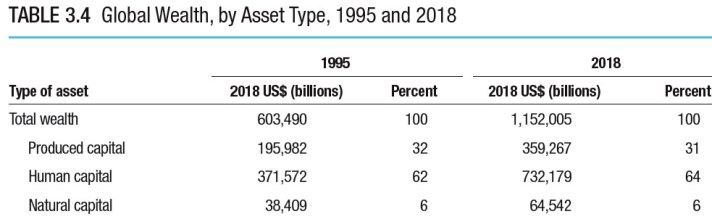
The wealth of a society is so much more than the value of houses, or the stock market, or retirement accounts. Wealth broadly understood should also include endowments of nature, ranging from wilderness to oil wells, as well as the human capital embodied in the education and skills of its people. Every few years, the World Bank takes on the task of measuring the world’s wealth in these broader ways. The most recent set of estimates appear in The Changing Wealth of Nations 2021 : Managing Assets for the Future.

Just to be clear, wealth represents an accumulation over time. This is different from GDP, which is the amount produced in a given year. Thus, world GDP in 2018 was about $86 trillion, but world wealth as estimated in this report was 13 times bigger at $1,152 trillion. Here are some estimates from “Chapter 3: Global and Regional Trends in
Wealth, 1995–2018,” by Glenn-Marie Lange, Diego Herrera, and Esther Naikal.

Here is how wealth was distributed around the world between countries of different income levels (I have left out some intermediate years in the table):

High-income countries like the US have about four times the per capita wealth of upper-middle income countries like Brazil, China, and India; about eight times the per capita wealth of lower middle-income countries like Nigeria, Indonesia, and Egypt; and 18 times the per capita wealth of lower-income countries like Uganda, Syria, and Ethiopia.

Again, the wealth being discussed here is not just financial or in the form of machinery and buildings, but includes the value embodied in natural and human resources.

However, countries with different income levels also tend to differ on the form of their wealth. The low-income countries in the top row have 23% of their wealth in the form of natural capital. The high-income non-OECD countries, who tend to be big oil producers and exporters, have almost one-third of their wealth in the form of nonrenewable natural capital. The high-income and upper-middle income countries (this second category driven largely by China) has about two-thirds of its wealth in human capital.

There are of course roughly a jillion ways to quarrel with these kinds of calculations: for those who wish to do so, I commend the detailed discussion of the World Bank volume and the underlying working papers to your attention. Here, I’ll just emphasize a few points.

  1. A nation’s wealth does not gain by using up nonrenewable natural resources. It’s like spending money from a savings account. Thus, a goal for countries rich in natural resources should be to make sure the renewable resources (say, forests) do actually get renewed, and to move the economy gradually away from depending on production of nonrenewable resources.
  2. For every group of countries, the wealth embodied in the education and skills (and health) of people is much more important than the wealth from produced capital–which includes everything physical from houses to business equipment. I sometimes think that from an economic point of view, pretty much everything cycles back to human capital sooner or later.
  3. In an important way, the wealth calculations here are likely to understate the wealth difference across countries, broadly understood. Economic production is heavily influenced by knowledge capital, by which I mean to include not just technology from research but all the ways in which private firms and public institutions support the functioning of an economy. These kinds of knowledge and institutional capital are probably just as important in considering a broad definition of wealth than “produced capital”–but much harder to estimate.

The Case for Putting a Lid on Downtown Freeways

Major freeways offer substantial economic benefits to an urban area or region. If you doubt it, try to name a major US economic center that is disconnected from the interstate highway system. But major freeways are not a win-win for everyone within an urban area. Often, they are a win for the suburban residential areas that have better connections to central downtown business districts, and for the central business districts that have access to a wider pool of workers. However, freeways often represent a loss for residential areas within cities. These areas already had fairly easy access to downtown, so they benefit little from the additional freeway access; indeed, the addition of freeways can make it harder for them to get downtown. Living beside a major highway is widely viewed as a negative. Moreover, major highways divide up and segment urban neighborhoods, in a way that makes walking, driving, or shopping more difficult, and in some cases will cut neighborhoods off from amenities like parks or access to waterfront.

Some cities are wondering if new construction projects might mitigate some of these costs. Boston’s “Big Dig” project, as one example, took the main highway running through downtown, buried it in a 1.5-mile long tunnel, and put a “greenway” through the city on top. In San Francisco, after the Loma Prieta earthquake in 1989 damaged the Embarcadaro freeway that had cut across the city, a decision was made to eliminate that freeway rather than rebuilding it. Dallas built a public park over the top of a freeway in 2012. In Atlanta, Philadelphia, and my own metro area of Minneapolis-St. Paul, there are speculative proposals about whether it might be worth putting a “lid” over a major freeway in a way that would reconnect neighborhoods and provide space for additional housing.

Jeffrey Brinkman and Jeffrey Lin of the Philadelphia Fed discuss the issues in “The Costs and Benefits of Fixing Downtown Freeways,” subtitled “Urban freeways spurred our suburban boom. Can burying them do the same for the urban core?” (Economic Insights, Winter 2022, 7:1, pp. 17-22). They write:

Using fine geographic data covering 1950 to 2010, we studied long-run changes in neighborhoods before and after the interstate highway system was built (Figure 1). We find that in the group of central- city neighborhoods closest to freeways, population declined by 32 percent, while in the group of central neighborhoods more than 2 miles from freeways, population actually grew by 56 percent.

To explore the potential costs and benefits of capping a stretch of freeway, Brinkman and Lin consider a large-scale project that would involve burying a 4.5-mile stretch of I-95, a major freeway that runs through downtown Philadelphia. As they point out, when I-95 was built 60 years ago, the area along the Delaware River was a declining industrial zone. Now, it would be possible to reshape that area into a waterfront park–if it wasn’t effectively cut off from much of the downtown by the freeway.

Of course, estimates of costs and benefits of this kind of project need to be taken with a dose of skepticism, but in rough numbers, it looks like this. The costs of these freeway-capping projects seem to vary from $300 million to $700 million per mile. Take a mid-range value of $500 million per mile, and capping the 4.5-mile stretch would cost $2.25 billion. Their simulations suggest that the project would dramatically increase population density and land values in the area: “The first result of the experiment is that population near the freeway increases drastically, with population densities of employed individuals in neighborhoods near the freeway increasing by as much as 2,840 people per square mile after the intervention. Overall, for neighborhoods within one mile of the freeway project, population increases by 7 percent in this scenario. Land prices in these same neighborhoods increase by 2.4 percent.” They estimate the total benefits at $3.5 billion.

There are of course all sorts of other issues here. Reasonable skeptics will note that if the costs of capping the freeway come in closer to $700 million per mile or above, the balance of gains over costs becomes much smaller. The results also turn on estimates of how much people would value the gain in amenities from living in neighborhoods not disrupted by a freeway and with easy access to a riverfront park. They write: “If we use values at the high end of existing estimates, the benefits of mitigation can increase by 100 percent, whereas low-parameter estimates can reduce the benefits by about 30 percent.” There’s also the practical question of who will pay for the project. The authors point out that since the benefits are concentrated in certain areas of Philadelphia, one can imagine that a substantial share of the costs would and should could be covered by a targeted property tax assessment.

It’s impossible to make some blanket statement about whether putting a lid over highways or burying them in tunnels will be worthwhile. But it’s not a crazy idea. In some cases, it may be well worth the costs–and a key to resuscitating urban neighborhoods have long suffered from their proximity to freeways.

What Do K-12 Schools Really Need?

What if US public schools were given a huge chunk of money that they could spend on pretty much whatever they wanted? What would they do? We are in the process of finding out. As Marguerite Roza and Katherine Silberstein discuss “A year ago, school districts got a windfall of pandemic aid. How’s that going?” (Brookings Institution, March 31, 2022). They begin: “T]his month marks one year since Congress approved the largest-ever one-time investment in public education: ESSER III, as it’s known, averaged $2,400 per student. This latest round of money left the federal treasury at warp speed, with $80 billion out the door in less than two weeks. From there, the aid went to state education agencies, where it sat. And sat. And nearly all of it still sits today.” 

A bit of background is probably useful here. ESSER stands for Elementary and Secondary School Emergency Relief (ESSER) Fund. The National Council on State Legislatures explains:

The Coronavirus Aid, Relief and Economic Security (CARES) Act, passed on March 27, 2020, provided $13.5 billion to the ESSER Fund. The Coronavirus Response and Relief Supplemental Appropriations Act, 2021 (CRRSA), passed on Dec. 27, 2020, provided $54.3 billion in supplemental ESSER funding, known as the ESSER II fund. The American Rescue Plan Act, passed on March 11, 2021, provided $122.7 billion in supplemental ESSER funding, known as the ESSER III fund.

There is a federal webpage that tracks not whether states have received the money (they have) or whether plans have been made to spend the money, but whether the money has actually been spent. There is a use-it-or-lose-it date of September 2024 for these funds, and Roza and Silberstein point out that at the current pace, the funds will not actually be spent. Of the funds that have been spent, how was the money used?

The law gives districts wide latitude and few restrictions, and thus choices are all over the map. One district awards sizable staff bonuses, another remodels a building, and another hires an army of counselors, nurses, and social workers. Some are launching tutoring efforts, while others are investing in professional development or refreshing their curriculum and technology. Atlanta added 30 minutes to the school day and Boston is running summer recovery courses for teens. Some are doing a bit of everything.

In many regions, the flurry of spending has triggered a corresponding flurry of hiring. Districts are competing for a limited labor pool, and using signing bonuses, retention pay, and other strategies to expand labor rolls to a new and higher level than ever before.

In contrast, some big, urban districts, including those in Minneapolis, Sacramento, San Francisco, and Los Angeles, are using funds to backfill budget gaps (some caused by pre-pandemic overspending or enrollment losses). Instead of launching new programs and hiring new staff, the funds are paying the salaries of staff who’ve been in these districts for years.

In the end, there simply is no “typical” spending profile.

It is perhaps worth noting that these ESSER funds are clearly not effective at providing a quick stimulus for the economy–they would have to be spent to do that. But K-12 schools do face an enormous challenge. The pandemic has left behind an enormous and nationwide pattern of “learning loss”–that is, students who have aged a couple of calendar years but have not gained the learning that would otherwise have been expected. Roza and Silberstein are blunt about the prospects that the ESSER funding will address the learning loss problem:

All told, this means we’re counting on leaders in thousands of districts to figure this out on the fly—and fast. And they’re expected to do so with no established data systems that could point the way. Some district investments will put student learning back on track and others won’t. Only in a few years will we have any indication of which districts did what and whether it worked. In that sense, the American Rescue Plan’s strategy might be best described as: fund and pray.

What should be done with the money? American K-12 school districts are wildly heterogenous, both across and within states, so it’s not easy to stay. Evidence from before the pandemic suggests that a combination of summer school and intense tutoring can help.

The Aspen Economic Strategy group recently published a book with eight essays appearing on Rebuilding the Post-Pandemic Economy (November 2021). Nora Gordon and Sarah Reber contribute an essay on “Addressing Inequities in the US K-12 Education System.” They provide an overview of the US K-12 education system, and offer a reminder that many students and schools were already facing substantial issues before the pandemic. I was struck by this figure showing cross-state differences in K-12 education. In particular, the middle column shows revenue per student across US states, while the final columns shows the differences in how states depend on local, state, and federal revenue.

They also point out:

Discussions of school funding equity—and considerable legal action—focus on inequality of funding across school districts within the same state. While people often assume districts serving disadvantaged students spend less per pupil than wealthier districts within a state, per-pupil spending and the child poverty rate are nearly always uncorrelated or positively correlated, with higher-poverty districts spending more on average. Typically, disadvantaged districts receive more state and federal funding, offsetting differences in funding from local sources.

They discuss evidence on a variety of possible K-12 school reforms, with an emphasis on the importance of the basics: high quality teachers and principals focused on a core curriculum. I was struck by this comment:

Quick fixes are few and far between, but improvements to school infrastructure stand out as low-hanging fruit. … Research shows that spending on capital improvements or to build new schools improves test scores and other outcomes (Jackson and Mackevicius 2021). Though the CDC notes there is no safe level of lead exposure for children, 37% of schools that test for lead reported elevated lead levels; fewer than half of districts even tested (GAO 2018b). Evidence that poor indoor air quality and exposure to lead and other toxins impedes learning and can have long-term effects is now conclusive (Aizer et al. 2018; Stafford 2015). Approximately one-third of schools require HVAC updates (GAO 2020). Studies also show that heat impacts learning adversely, especially when schools do not have air-conditioning (Park et al. 2020; Park, Behrer, and Goodman 2021). Schools serving low-income students and students of color are more likely to lack air conditioning conditional on other factors, and Park et al. (2020) estimate that heat accounts for 1 to 13% of U.S. racial achievement gaps. Installing air conditioning could plausibly help shrink achievement gaps.

America’s K-12 schools have an opportunity to show what they can do with a substantial infusion of public funds. The schools also face ongoing risks to their reputation and public support if they do not rise to the moment.

Interview with Arvind Subramanian: India’s Economy

Noah Smith serves as interlocutor in “Interview: Arvind Subramanian, former Chief Economic Advisor to the Government of India” (Noahopinion, April 1, 2022). The interview is subtitled “Everything you wanted to know about India’s economy,” and it makes a strong bid to fulfill that promise. I was of course very pleased that Subramanian refers to the papers published in the Winter 2020 issue of the Journal of Economic Perspectives (where I work as Managing Editor) in a “Symposium on the Economics of India”:

Here are some tidbits from Smith’s interview with Subramanian, but the interview itself goes into greater depth. I’ll start with Subramanian’s overview of India’s economic development in recent decades.

India had more than 3 decades of really rapid growth beginning, late 1970s-early 1980s. Per capita GDP growth averaged close to 4.5 percent and as I wrote in a JEP paper (co-authored with Rohit Lamba: https://pubs.aeaweb.org/doi/pdfplus/10.1257/jep.34.1.3), India’s dynamism was quite remarkable by cross-country standards. Poverty rates declined, access to goods and services increased sharply, public infrastructure improved. And dynamism was especially marked for close to a decade between 2003 and 2012 when India may have grown even faster than China. NPR had a even coined a catchphrase—“the world’s fastest growing, free-market democracy”—as its way of encapsulating the world’s admiration, even astonishment, as India seemed to vault effortlessly from a nation mired in poverty into a modern high-tech, car-owning middle-class society. China was the world’s factory but India was going to be its back-office. That was the expectation.

In the decade after the global financial crisis (GFC), especially after 2011, growth slowed considerably. Of course, there were exogenous factors as the world economy slowed down and globalization went into retreat. But India’s growth slowdown was sharper than for other countries, reflecting India-specific factors.  

Initially (2011-2014), it reflected macro-economic mismanagement, corruption and decision-making paralysis which led to the near-crisis of the 2013 Taper tantrum. Later (post-2014) it reflected the inability of the government and central bank to address India’s Twin Balance Sheet challenge: over-indebtedness of corporates and the counterpart rising NPAs in the banking system which had financed much of the infrastructure boom of the oughties. This was a classic Japan-style problem that India did not really solve (and truth be told, did not even really embrace as diagnosis). Private investment and credit growth have been virtually flat in the last decade. And export growth was weak too. … As India emerges from the pandemic, the big challenge is: how do you revive private investment and trade (the long-run engines of growth) and in a manner that creates jobs?

India has become internationally known as a supplier and competitor in information technology markets. However, an ongoing concern has been that this emphasis doesn’t do much to offer jobs for low-skilled workers, and thus is an unbalanced strategy for economic development. Here’s Subramanian:

Great strides have not just been made in physical but digital infrastructure. In 2015, I coined a term JAM which represented the coming together of financial inclusion (the J from the Hindi “Jan Dhan”), biometric identity (the A for “Aadhaar”) and telecommunications (the M for mobile). The government has used this trinity for a variety of purposes, including making direct cash transfers to the poor. In addition, a public-private partnership has created a digital, non-proprietary platform called the Unified Payment Interface (UPI) which is driving a lot of private dynamism and innovation in a number of sectors–finance, tourism, e-commerce, software solutions etc. I like to joke that India is creating unicorns roughly at the rate that it is creating chess grandmasters. While cause for cheer, this dynamism, based on skill- and technology-intensive factors of production, cannot drive structural transformation because that requires creating jobs for India’s vast, relatively less skilled labor force. And India’s job situation, especially after the pandemic, is sobering.

Which leads to your question about why India has not really managed to achieve scale in its manufacturing operations and why Indian capital is reticent in doing so. I suspect, although I am not sure, that there is again a lot of path-dependence here.  For a long time under the license Raj [a term for India’s heavy-handed economic regulations in the decades before the 1980s], domestic entrepreneurship was penalized. And there was a particular aversion to size, fearing the economic and political power that large firms could wield. … So, paradoxically, labour feels vulnerable to the power exercised by large firms but equally capital does not feel protected by the state either. So, we are in a bad equilibrium that favors small over big.    

How does the Russian invasion of Ukraine affect or offer opportunities for India?

The Russian invasion of Ukraine has, of course, thrown up new challenges.  One would expect the Indian government and business to scent significant opportunities here. One expects that responses (sanctions) to the Russian invasion will increasingly force investors to be more sensitive to the nature of political regimes where they operate, intensifying already-existing pressures to shift production out of Russia today and possibly China tomorrow. Similarly, access to foreign markets for goods exported from such regimes has also become more uncertain. 

Against this background, a democratic India should be, and see itself as, more attractive to the fleeing investors. Surprisingly though, there is growing concern that India itself might be targeted in the future for similar actions by the West. The argument is that if the US can act against Iran or Venezuela or Russia for geo-strategic reasons, pretexts can always be found for freezing Indian assets in the future or raising barriers to Indian goods and services. Talk has therefore begun about indigenizing payments systems to reduce reliance on the dollar-based system, diversifying foreign exchange reserves and negotiating barter trade agreements. 

Such costly deglobalizing actions would be in keeping with and even re-inforce the government’s inward turn. In the  last few years, India has raised tariff barriers, implemented selective industrial policy and stayed out of integration agreements, especially in dynamic Asia. Freer trade and more intensive economic engagement with the world now risk becoming serious casualties of recent developments. …

Since sanctions against Russia are raising concerns that India could be targeted in the future, the US must work toward convincing India that there is more opportunity than threat here, and that the US will help India become the hedge against the increasing unreliability of China and the Asian value chain. For example, Devesh Kapur suggests that the US could nudge/incentivize American firms to make India the next Taiwan in terms of chip/semi-conductor production capability. Of course, the Indian government will have to do its bit–quite a bit–to create the appropriate regulatory environment and assure investors that the playing field will be level. 

How Does an Economics Major Cause Higher Incomes?

It’s well-known that those who major in economics earn more, on average, than those who major in other social sciences or in the humanities. But why? One possibility is that those who are more interested in earning income or in industries that tend to pay more will be more likely to become economics majors. Thus, the higher pay of economics majors might just reflect this sorting of pre-existing preferences, not any causal effect of majoring in economics.

To determine if majoring in economics causes higher incomes in the ideal world of social scientists, one might want to experiment with a large group of students, who would be randomly assigned to majors and then we could track their life outcomes. For good and obvious reasons, that experiment is impractical. However, with a dollop of research creativity, it is possible to look for a “natural experiment” where real-world experience approximates this ideal social science experiment. Zachary Bleemer and Aashish Mehta find a way to do this in “Will Studying Economics Make You Rich? A Regression Discontinuity Analysis of the Returns to College Major” (American Economic Journal: Applied Economics 2022, 14:2, 1–22, ).

The authors focus on a specific rule at the University of California-Santa Cruz: If a student doesn’t have a grade point average of at least 2.8 in the two introductory economics courses, that student (usually) cannot go on to major in economics. We can reasonably assume (and this assumption can be checked) that students who are just a little above the 2.8 cut-off are in many ways quite similar to those just below the 2.8 cut-off, except for a few points awarded (or not awarded) on a midterm or a final exam. Thus, the authors focus not on comparing all econ majors to all non-econ majors, but instead just compare those slightly above or below the grade cut-off.

This methodology is called “regression discontinuity.” Basically, it looks at at those just above or below a certain cutoff, which can be grades or income or qualifications for a certain program or any number of things. Comparing those just above and just below the cutoff is close to a hypothetical randomized experiment: that is, you have a group of very similar people, and because some are a tick above and others are a tick below the cutoff, some are eligible for a certain program and some are not. At least as a first approximation, subject to later in-depth checking, it’s reasonable to view later differences between those just-above and just-below the cutoff as a causal effect. The authors write:

Students who just met the GPA [grade point average] threshold were 36 percentage points more likely to declare the economics major than those who just failed to meet it. Most of these students would have otherwise earned degrees in other social sciences. Students just above the threshold who majored in economics were surprisingly representative of UCSC economics majors on observables; for example, their average SAT score was at the forty-first percentile of economics majors.

Comparing the major choices and average wages of above- and below-threshold students shows that majoring in economics caused a $22,000 (46 percent) increase in the annual early-career wages of barely above-threshold students. It did so without otherwise impacting their educational investment—as measured by course-adjusted average grades and weekly hours spent studying—or outcomes like degree attainment and graduate school enrollment. The effect is nearly identical for male and female students, may be larger for underrepresented minority students, and appears to grow as workers age (between ages 23 and 28). About half of the wage effect can be explained by the effect of majoring in economics on students’ industry of employment: relative to students who did not qualify for the major, economics
majors became more interested in business and finance careers and were more likely
to find employment in higher-wage economics-related industries like finance, insurance, and real estate (FIRE) and accounting.

For comparison, the income difference between economics majors as a group and non-econ majors is not a lot larger than this: “Forty-year-old US workers with undergraduate degrees in economics earned median wages of $90,000 in 2018. By comparison, those who had majored
in other social sciences earned median wages of $65,000, and college graduates with any major other than economics earned $66,000.”

Thus, this finding suggests that a large part of the income difference between econ majors and other majors is a causal effect of the economics major. In addition, a much of the difference is because those who are just-above the 2.8 cut-off are much more likely to end up in certain categories of high-paying jobs than those who were just below the cut-off. The data in this study can’t answer the underlying question of why this might be so. Do economics majors have an academic background that makes them more suited for such jobs? Do economics majors have a culture that is more supportive of looking for such jobs? Do employers in these sectors have a preference for economics majors over other majors? Whatever the underlying reason, becoming an economics major does seem to have a substantial causal effect on later career choices and income.


Interview with Lawrence Summers: Inflation and the Economy

It’s not common. But every now and then, a prominent economist will make a strong near-term prediction that flies in the face of both mainstream wisdom and their known political loyalties. Lawrence Summers did that back in March 2021. As background, Summers was Secretary of the Treasury for a couple of years during the Clinton administration and head of the National Economic Council for a couple of years in the Obama administration. Moreover, he is someone who has been arguing for some years that the US economy needs a bigger boost in demand from the federal government to counter the forces of “secular stagnation” (for discussion, see here and here). Thus, you might assume that Summers would have been a supporter of the American Rescue Plan Act of 2021, backed by the Biden administration and signed into law in March 2021.

Instead, Summers almost immediately warned that this rescue package, when added to the previous pandemic relief legislation, would increase demand in the economy in a way that would be likely to set off a wave of inflation. There was some historical irony here. Back during the early years of the Obama administration when the US economy was struggling to rebound from the Great Recession, Summers was a prominent supporter of increased federal spending at that time–often warning that the problem was likely to be doing too little rather than doing too much. Some opponents of the 2009 legislation predicted that it would cause inflation, but it didn’t happen. Now in March 2021, Summers was on the “it’s too big and will cause inflation” side of the fence.

Jump forward a year to March 2022, and Summers looks prescient. Yes, one can always argue that someone made a correct prediction, but that they did so for the wrong reasons, and events just evolved so that their prediction luckily turned out to be true. And one can also argue that all those making the wrong prediction about inflation back in spring 2021 were actually correct, but events just evolved in an unexpected way so that just by bad luck they turned out to be wrong. But maybe, just maybe, those who were wrong have something to learn from those who were right.

Ezra Klein has an hour-plus interview with Larry Summers, which Klein titles “I Keep Hoping Larry Summers Is Wrong. What if He’s Not?” (New York Times website, March 28, transcript and audio available). Here are some points that caught my eye.

On the current economic dangers

I’m probably as apprehensive about the prospects for a soft landing of the U.S. economy as I have been any time in the last year. Probably actually a bit more apprehensive. In a way, the situation continues to resemble the 1970s, Ezra. In the late ’60s and in the early ’70s, we made mistakes of excessive demand expansion that created an inflationary environment.

And then we caught really terrible luck with bad supply shocks from OPEC, bad supply shocks from elsewhere. And it all added up to a macroeconomic mess. And in many ways, that’s the right analogy for now. Just as L.B.J.’s guns and butter created excessive and dangerous inflationary pressure, the macroeconomic overexpansion of 2021 created those problems, and then layered on with something entirely separate, in terms of the further supply shocks we’ve seen in oil and in food.

And so now I think we’ve got a real problem of high underlying inflation that I don’t think will come down to anything like acceptable levels of its own accord. And so very difficult dilemmas as to whether to accept economic restraint or to live with high and quite possibly accelerating inflation. So I don’t envy the tasks that the Fed has before it. …

On how short-term stimulus can be a bad idea if it leads to long-term costs

I share completely the emotional feelings that you describe around the benefits of a strong economy. But I think it’s very important not to be shortsighted and to recognize that what we care about is not just the level of employment this year, but the level of employment averaged over the next 10 years. That we care not just about wages and opportunities this year, but we care about wages and opportunities over the long-term.

And the doctor who prescribes you painkillers that make you feel good to which you become addicted is generous and compassionate, but ultimately is very damaging to you. And while the example is a bit melodramatic, the pursuit of excessively expansionary policies that ultimately lead to inflation, which reduces people’s purchasing power, and the need for sharply contractionary policies, which hurt the biggest victims, the most disadvantaged in the society, that’s not doing the people we care most about any favor. It’s, in fact, hurting them.

The excessively inflationary policies of the 1970s were, in a political sense, what brought Ronald Reagan and brought Margaret Thatcher to power. So I share your desires. I think the purpose of all of this is to help people who would otherwise have difficulty. That is what it’s all about in terms of making economic policy. But if you don’t respect the basic constraints of situations, you find yourself doing things that are counterproductive and that in the long-run prove to be harmful.

You raise an interesting example when you talk about wage increases. If you look at the rate of wage increases, percentage wage increases each year for the American economy, and then you look at the increase in the purchasing power of workers each year, what you find is that as wage increases go up, the growth of purchasing power increases until you get to 4 percent or 5 percent. And when wage increases start getting above 4 percent or 5 percent, then you start having serious inflation problems and actually the purchasing power of workers is going down.

So my disagreement with policies that were pursued last year had nothing to do with ends. I completely shared the end. I did not care about inflation for its own sake. But what I did care about was real wage growth over time, average levels of employment and opportunity over time, and a sense of social trust that would permit progressive policies.

And I thought those vital ends were being compromised by those with good intentions but a reluctance to do calculations. And I have to say that the early evidence at this point — and it gives me no pleasure to say this — but the evidence at this moment in terms of what’s happened to real wages, in terms of what’s happened to concerns about recession, in terms of what political prognosticators are saying, suggests that those fears may, to an important extent, have been justified.

What does the Federal Reserve need to do?

I don’t think we’re going to avoid and bring down the rate of inflation until we get to positive real interest rates. And I don’t think we’re going to get to positive real interest rates without, over the next couple of years, getting interest rates north of 4 percent. What happens to real interest rates depends both on what the Fed does and on what happens to inflation.

My sense of this is that given the likely paths of inflation, we’re likely to have a need for nominal interest rates, basic Fed interest rates, to rise to the 4 percent to 5 percent range over the next couple of years. If they don’t do that, I think we’ll get higher inflation. And then over time, it will be necessary for them to get to still higher levels and cause even greater dislocations.

Brazil’s Pix System: Electronic Payments for 67% in a Year

One of the frustrations of the modern US economy is that it costs money to make payments. Credit cards have fees. Banks have fees. Electronic payment systems have fees. Paying by cash doesn’t have an explicit fee, but it does have the implicit costs and risks of walking around carrying cash–and a growing number of merchants don’t take cash. One estimate is that US consumers pay 2.3% of GDP just for payment services, and while that is relatively high, payment services are more than 1% of GDP in many countries.

Brazil decided on an alternative approach. The basic idea is that the Brazil Central Bank (BCB) has set up a platform for payment service providers. The central bank sets up the “application programming interfaces,” which essentially means that there is a common technology through which payment services providers can accessing the system. The central bank owns and operates the platform itself, and all large banks and other payment services providers are required to participate. If two parties are using different service providers, they can still readily make a transaction over the shared platform. From the launch of the system in November 2020, it went from zero to 67% of Brazil’s adult population in its first year. Angelo Duarte, Jon Frost, Leonardo Gambacorta, Priscilla Koo Wilkens and Hyun Song Shin tell the story in “Central banks, the monetary system and public
payment infrastructures: lessons from Brazil’s Pix”
(Bank of International Settlements, BIS Bulletin #52, March 23, 2022). Here’s a description:

The BCB [Brazil Central Bank] decided in 2018 to launch an instant payment scheme developed, managed, operated and owned by the central bank. Pix was launched in November 2020. The goals are to enhance efficiency and competition, encourage the digitalisation of the payment market, promote financial inclusion and fill gaps in currently available payment instruments. The BCB plays two roles in Pix: it operates the system and it sets the overall rulebook. As a system operator, the BCB fully developed the infrastructure and operates the platform as a public good. As rulebook owner, the BCB sets the rules and technical specifications (eg APIs) in line with its legal mandate for retail payments. This promotes a standardised, competitive, inclusive, safe and open environment, improving the overall payment experience for end-users.

Since its launch, Pix has seen remarkable growth. By end-February 2022 (15 months after launch), 114 million individuals, or 67% of the Brazilian adult population, had either made or received a Pix transaction. Moreover, 9.1 million companies have signed up – fully 60% of firms with a relationship in the national financial system. Over 12.4 billion transactions were settled, for a total value of BRL [Brazilian reais] 6.7 trillion (USD 1.2 trillion) (Graph 1, left-hand panel). Pix transactions have surpassed many instruments previously available – eg pre-paid cards – and have reached the level of credit and debit cards (Graph 1, right-hand side). Pix partly substituted for other digital payment instruments, such as bank transfers. Yet notably, the total level of digital transactions rose substantially. Using accounts from banks and non-bank fintech providers, more individuals entered the digital payment system. Indeed, Pix transfers were made by 50 million individuals (30% of the adult population) who had not made any account-to-account transfers in the 12 months prior to the launch of Pix. Thus, Pix helped to expand the universe of digital payment users.

Credit transfers between individuals have been the main use case for Pix since its launch. Indeed, adoption by individuals is very straightforward. Individuals can obtain a Pix key and quick response (QR) code to initiate transfers to friends and family, or for small daily transactions. In line with its strategic agenda for financial inclusion, the BCB decided to make Pix transfers free of charge for individuals. PSPs pay a low fee (BRL 0.01 per 10 transactions) to the BCB so that the BCB can recover the cost of running the system.

To ensure access and integrity, PSPs must digitally verify the identity of users. With the existing interface and know-your-customer (KYC) processes provided by their bank or non-bank PSP, users can have an “alias” – such as a phone number, email address or other key – which forms the basis of digital identification. The most common such aliases are randomly generated keys (eg QR codes), but phone numbers, email addresses and tax IDs are also used … The ease of use for individuals and the multiplicity of use cases may be one reason why actual use has increased quite rapidly …

Brazil’s Pix system is still quite new, and one suspects there will be growing pains: security breaches, fraud, efforts by private actors to use the system to reduce competition, and so on. But the experiment itself may teach lessons about how a country can simultaneously expand access to electronic transactions while dramatically reducing the fees imposed by current payment systems, and thus is deeply interesting.

Inflation: Many Prices Rising or Just a Few?

Is the ongoing inflation in the US economy more likely to be a temporary burst that will fade away, or a longer-term pattern that will require a policy reaction? One way to get some insight into this question is to look at whether many prices are rising briskly or only a few. If inflation is being driven up by just a few prices–say, energy prices–then an overall inflationary momentum has not yet spread to the rest of the economy. However, if a wide array of prices have been rising, then a broader inflationary momentum becomes a more plausible story. Alexander L. Wolman of the Richmond Fed carries out the calculations in “Relative Price Changes Are Unlikely to Account for Recent High Inflation” (March 2022, Economic Brief 22-10).

Wolman breaks up the economy into roughly 300 consumption categories. For each category, there is data on the changes in prices as well as quantity of the good consumed. Thus, one can look at whether overall inflation is emerging from relatively few or many categories of goods–and how this pattern has changed in the last year or so.

As one example, he calculates the share of expenditures, using the 300+ categories of consumption, that account for 50% of inflation: that is, does a relatively small or large share of expenditures account for half of the inflation? Each dot in the figure below is monthly data going back to 1995. As you can see on the vertical axis, monthly inflation rates were low during much of this time, often in the range of 0.2% or less. The horizontal axis shows that the share of expenditures accounting for half of this low inflation rate was also often quite small, often in the range of 2-4% of all expenditures.

However, the colored dots show more recent months from the start of the inflation in March 2021 (yellow dot) up through January 2022 (purple dot). As you can see on the vertical axis the monthly inflation rate has bee substantially higher during this time, often at about 0.6%. But look at how the colored dots spread out horizontally. Back in March 2021 (yellow) and April 2021 (green) , half of inflation was coming from about 3% of expenditures, a common earlier pattern. But by December 2021 (orange) and January 2022 (purple), half of the higher inflation rate was coming from about 12% of expenditures. In other words, price changes across a much wider swath of the economy were driving inflation–a sign that inflation had become more entrenched.  

Here’s a different calculation reaching a similar conclusion. In any given month, what share of relative price increases are above or below the inflation rate? Again, you can see that in March 2021 (yellow) and April 2021 (green), a smaller share of price increases were above the overall inflation rate, but in January 2022, almost half the prices are rising at above the average rate.

The message I would take away from these calculations is that it was plausible in the summer of 2021 to think that inflation was mainly a few price changes, perhaps due to short-term factors and supply disruptions, that would fade. But the growing number of consumption categories with substantial prices makes that interpretation less plausible. In addition, this data doesn’t take into account the more recent disruptions and price hikes associated with the Russian invasion of Ukraine and the economic sanctions that have followed.

Schlesinger: On the Quality of State Department Writing During the Kennedy Administration

The Russian invasion of Ukraine has led to me reading more about foreign affairs and international relations than usual, which in turn reminded me of Arthur M. Schlesinger’s comments about the quality of writing in the US State Department. Schlesinger was a Harvard history professor who became a “special assistant” to President John F. Kennedy. In 1965, he published a memoir titled A Thousand Days: John F. Kennedy in the White House. Here’s his discussion of the internal battles over the quality of writing emanating from the US Department of State (pp. 418-419). I’m especially fond of a few of his comments:

“The writing of lucid and forceful English is not too arcane an art.”

“At the very least, each message should be (a) in English, (b) clear and trenchant in its style, (c) logical in its structure and (d) devoid of gobbledygook. The State Department draft on the Academy failed each one of these tests (including, in my view, the first).”

Here’s the fuller passage:

After the Bay of Pigs, the State Department sent over a document entitled “The Communist Totalitarian Government of Cuba as a Source of International Tension in the Americas,” which it had approved for distribution to NATO, CENTO, SEATO, the OAS and the free governments of Latin America and eventually for public re- lease. In addition to the usual defects of Foggy Bottom prose, the paper was filled with bad spelling and grammar. Moreover, the narrative, which mysteriously stopped at the beginning of April 1961, contained a self-righteous condemnation of Castro’s interventionist activities in the Caribbean that an unfriendly critic, alas! could have applied, without changing a word, to more recent actions by the United States. I responded on behalf of the White House:

It is our feeling here that the paper should not be disseminated in its present form. …

Presumably the document is designed to impress, not an audience which is already passionately antiCastro, but an audience which has not yet finally made up its mind on the gravity of the problem. Such an audience is going to be persuaded, not by rhetoric, but by evidence. Every effort to heighten the evidence by rhetoric only impairs the persuasive power of the document. Observe the title: ‘The Communist Totalitarian Government of Cuba’… This title presupposes the conclusion which the paper seeks to establish. Why not call it `The Castro Regime in Cuba’ and let the reader draw his own conclusions from the evidence? And why call it both ‘Communist’ and ‘totalitarian’? All Communist governments are totalitarian. The paper, in our view, should be understated rather than overstated; it should eschew cold .war jargon; the argument should be carried by facts, not exhortations. The writing is below the level we would hope for in papers for dissemination to other countries. The writing of lucid and forceful English is not too arcane an art.

The President himself, with his sensitive ear for style, led the fight for literacy in the Department; and he had the vigorous support of some State Department officials, notably George Ball, Harriman and William R. Tyler. But the effort to liberate the State Department from automatic writing had little success. As late as 1963, the Department could submit as a draft of a presidential message on the National Academy of Foreign Affairs a text which provoked this resigned White House comment:

This is only the latest and worst of a long number of drafts sent here for Presidential signature. Most of the time it does not matter, I suppose, if the prose is tired, the thought banal and the syntax bureaucratic; and, occasionally when it does matter, State’s drafts are very good. But sometimes, as in this case, they are not.

A message to Congress is a fairly important form of Presidential communication. The President does not send so many — nor of those he does send, does State draft so many — that each one can- not receive due care and attention. My own old-fashioned belief is that every Presidential message should be a model of grace, lucidity and taste in expression. At the very least, each message should be (a) in English, (b) clear and trenchant in its style, (c) logical in its structure and (d) devoid of gobbledygook. The State Department draft on the Academy failed each one of these tests (including, in my view, the first).

Would it not be possible for someone in the Department with at least minimal sensibility to take a look at pieces of paper designed for Presidential signature before they are sent to the White House?

It was a vain fight; the plague of gobbledygook was hard to shake off. I note words like “minimal” (at least not “optimal’) and ‘pieces of paper” in my own lament.