Where Will America Find Caregivers as its Elderly Population Rises?

As we look ahead two or three decades into the future, we know several demographic facts with an extremely high degree of confidence. We know that that the number of elderly people in the population will be rising, and as a result, the demand for long-term care services will rise substantially. We also know that the birthrate has been falling, and so this generation of the eventually-will-be-elderly has had fewer children than the previous generation.

Put these two demographic facts together with a current social pattern: a large share of the care received by elderly adults with disabilities has been unpaid care provided by their children. But that arrangement will not be sustainable, at least not in the same way, moving forward. Three recent essays written for the Peter G. Peterson Foundation as part of its \”US 2050: Research Projects\” lay out some dimensions of the problem.

For example, here\’s an overview of the coming patterns from Stipica Mudrazija in \”Work-Related Opportunity Costs of Providing Unpaid Family Care\” (citations and references to tables omitted):  

Currently, there are almost 13 million caregivers aged 20-64 providing care to 10 million older adults with limitations in daily activities. In addition to the adult children of care recipients (71%), unpaid working-age caregivers to this population include spouses (5%), other family members (17%), and nonrelatives (7%). Overall, these caregivers account for 6.7 percent of the population aged 20-64, but the provision of caregiving is highly unequally  distributed by age as the majority of caregivers are aged 50-64, and adults in this age group are more than three times as likely to be caregivers than those aged 20-49. Accounting for future population aging and trends in physical disability and adjusting for compositional changes of the future population, the number of caregivers needed to keep the current prevalence of unpaid caregiving constant would have to almost double. This implies that the proportion of unpaid family caregivers to older adults would have to increase by more than a half to 6.1 percent for adults aged 20-49 and 19.2 percent for those aged 50-64. 

Thus, one potential future is that about one-fifth of adults from ages 50-64 become unpaid caregivers to the elderly. Of course, this pathway has tradeoffs. Caregivers typically spend less time in paid work: 

Using data from the National Study of Caregiving, the author finds that caregivers are about 9 percentage points less likely to be employed than those that do not provide care. In addition, employed caregivers work 2.1 fewer hours per week than their non-caregiver peers.  The current annual work-related opportunity cost of unpaid care in the United States is about $67 billion, but these costs will more than double by 2050. 

Mudrazija points out that in the past, analyses have suggested \”that the economic benefits of unpaid family care in terms of savings to government programs outweigh work opportunity costs.\” But this pattern seems to be shifting: \”Therefore, future discussions of the role of unpaid family care should recognize that this is a finite and increasingly expensive resource.\”

Gal Wettstein and Alice Zulkarnain focus on the question, \”Will Fewer Children Boost Demand for Formal Caregiving?\”  They note: \”Today, 25 percent of all caregivers of elderly are adult children. However, while the parents of the Baby Boom generation had three children per household on average, the Boomers themselves only have two.\” People with fewer children are more likely to end up in nursing homes–probably in part because they lack access to unpaid care and support from children. \”The authors estimate that, among people over age 50, having one fewer child increases the probability of having spent a night in a nursing home in the last two years by 1.7 percentage points—a magnitude comparable to the effect of having poor self-reported health, or of being ten years older.\”

Put these factors together, and the demand for paid care for the elderly is likely to skyrocket: \”They extrapolate this finding to 2050, and estimate that the decline in fertility of the Baby Boom generation will increase formal care demand per person by an extra 8.6 percent. Combined with the expected tripling of the population over age 85, the authors estimate that formal care demand will increase by about 326 percent relative to the current formal care demand.\”

Kristin Butcher and Tara Watson raise the issue of \”Immigration and Tomorrow’s Elderly.\”  They find:

\”[A]lthough the majority of the population age 80 and up has some type of disability or difficulty, fewer than 10 percent of individuals in their 80s live in an institution. This suggests either that they are getting help that keeps them out of institutions, or that there is an unmet need for such help. The authors identify eight key occupations that may help elderly individuals age in place, such as nursing aides and housekeepers, and predict that these occupations as a share of the overall workforce will increase from 8.4 percent to 12 percent in 2050. Further, they find that immigrants are disproportionately represented in these occupations. Assuming that the ratios of immigrants to total number of workers are fixed within occupations, the authors estimate that 42 million foreign-born workers would be required to maintain current immigrant representation in these fields. This is significantly more than the 30 million immigrants that are projected to be working in the U.S. in 2050.\” 

To put their point in  my own words, the US has been leaning on its immigrant workforce to provide paid caregiving to the elderly. As the number of elderly who need paid caregiving rises sharply, if unpaid care doesn\’t double in quantity to fill the gap,  higher levels of immigration is one way of increasing the workforce of caregivers.

For some previous posts on the coming challenges of providing long-term care, along with some international perspective, see:

Also, some readers may be interested in digging further into the \”US 2050: Research Projects\” from the Peterson Foundation.  There are 31 papers on topics including population trends, early investments in children, employment and adult workers, caregiving (the focus of this post), retirement, and politics. 

The Global Paper Industry: Still on the Rise

Paper is an old industry, dating back to 100 BC in China. For several decades now, there have been predictions that paper would decline, as businesses converted to the \”paperless office\” and as people moved to reading online rather than on dead tree. How is that transition going? The short answer is \”only OK.\” For a longer answer, the Environmental Paper Network offers a review in The State of the Global Paper Industry, subtitled \”Shifting Seas: New Challenges and Opportunities for Forests, People and the Climate\” (April 2018).

The report notes (footnotes omitted):

Paper use increases year on year and has quadrupled over the= past 50 years. In 2014, global paper production hit 400 million tonnes per year for the first time … More than half of this paper is consumed in China (106 million tonnes), the USA (71 million tonnes), and Japan (27 million tonnes), with a further quarter in Europe (92 million tonnes). The entire continent of Africa accounts for just 2% of global paper use, consuming a mere 8 million tonnes per year. Oceania and Latin America between them account for around 8%.

Here\’s a figure and a table showing total paper consumption by region over time Notice that paper consumption in North America has been falling. Paper consumption is near-zero in Africa and not much higher in Latin America and Oceania. It\’s rising fast in Asia, which is in large part a China effect. 
 
Here\’s a figure showing per capita consumption of paper, with North America still leading the way. 
Why has the demise of paper been so slow to arrive? As shown in the table above, one main reason is the growth of paper production in China. The report notes: \”China alone, with its rapid build-up of capacity over the past two decades, has taken over as the leading paper producer, providing more than 25% of the world’s paper.The USA, long the global leader in paper production, moved to second place in 2009.\” This pattern raises the possibility that paper consumption is also likely to rise substantially if and when economic growth proceeds in other parts of the world 
The other reason is that most consumption of paper products isn\’t about newspapers, reports, and other reading material. It\’s packaging. Here\’s a pie chart showing the breakdown of uses of paper in a recent year, and a figure showing the change over time. 

A main concern for the Environmental Paper Network is that paper production is often an environmentally dirty industry. The report notes: 

The pulp and paper manufacturing industry is one of the world’s biggest polluters and must evolve to employ best available technologies and new innovations to clean up its act. The sector is not only the fifth largest consumer of energy, accounting for 4% of all the world’s energy use, but the process of paper uses more water to produce one ton of product than perhaps any other industry. On average 10 litres of water are required to make one A4 sheet of paper – in some cases, it’s as high as 20 litres. The chemically intensive nature of the paper pulping and bleaching process is far from clean. The toxic chemicals used often end up being discharged as effluent into waterways where they pollute rivers, harm eco-systems, bio-accumulate and eventually enter the food chain. Besides carbon emissions, pulp and paper mills also release air pollutants in the form of fine particulate matter (PM2.5), nitrogen and sulphur oxides which can also affect public health. While the industry has made some progress in recent years to operate more sustainably, it has been slow to adopt advances in technology that can deliver higher energy savings and water reductions whilst promoting less toxic production methods.

The report is also careful to note that reductions in paper use don\’t always provide environmental benefits. Using paper towels in a public restroom is probably more environmentally friendly than a hot-air dryer.  Even the move from paper to digital communication can be tricky to convert into environmental pluses and minuses. The report notes: \”Life-cycle assessments of some commodities, for example of books, have compared the energy or climate change costs of paper and electronic alternatives, drawing conclusions about how many e-books need to be read on an e-reader before the unit energy costs are less than the paper option. Few of such studies adequately address the full life-cycle impacts of digital devices, including all the minerals used in their production and post-disposal impacts.\” 

Thus, the challenge in thinking about environmental effects of the paper industry is to focus on uses where the social benefits of paper are relatively low. The report uses the economics language of \”utility\” to discuss this subject, although the term isn\’t quite used in the textbook economics sense:

Some paper applications have considerable social benefits, and therefore high utility. Other applications have either no social benefits, a highly limited lifespan or much more durable alternatives (or more than one of these). They are therefore deemed to be low utility. In surveys of opinion of the utility of different paper applications, the results have assigned high utility to such items as legal papers, passports, money, medical records, toilet paper and books, and low utility to unread magazines, unwanted direct mail (junk mail), excessive packaging and throwaway cups. Reducing use in paper applications that are high volume and low utility can make a big impact, while not causing disadvantage. Excessive packaging, therefore, is an example of a good place to look for efficiencies. Reducing use of paper napkins, on the other hand, being low utility but also relatively low volume, will make less impact, while reducing the use of books, which are fairly high volume but also high utility, could be unpopular and limit the sharing of information by people that have no access to digital devices.

Measuring overall recycling in an economy is hard, and the statistics aren\’t great. But here\’s one set of estimates on the extent of paper recycling. 

Paper has its uses, and some of those uses seem likely to persist and even to rise with global economic growth. The challenge, as usual, is to strike a cleaner balance between economic benefits and environmental costs. 

Interview with William “Sandy” Darity Jr.: Inequality, Race, Stratification, and More

Douglas Clement interviews William \”Sandy\” Darity Jr. in The Region magazine from the Federal Reserve Bank of Minneapolis (June 3, 2019). As the subtitle reads: \”His recent focus has been on reparations for African Americans, but his scholarship spans decades and ranges from imperialism to psychology, from “price-specie flow” to rational expectations.\” Here are a few points that caught my eye, but the entire interview is worth reading.

Wealth Inequality by Race

The racial wealth gap is customarily measured at the median for households to bypass the problems that are created by large outliers. At the median, when we’re taking the middle households, the most recent data from the Survey of Consumer Finances (SCF) for 2016, I believe, places the white household median at $171,000 and the black household median at $17,600. So, essentially, at the median, blacks have 1 cent in wealth to every 10 cents held by whites. [The SCF 2016] probably has the most conservative estimate of the gap. If, for example, you use the Survey of Income and Program Participation from 2014, which I believe is the most recent year that it’s been taken, the ratio is closer to 1 cent for blacks per 13 cents for whites at the median.

In work that our research group has done for the National Asset Scorecard for Communities of Color, we attempted to get data about individual metropolitan areas throughout the United States, where it might be possible to look at the wealth position of very specific national origin groups. All of our cities have much lower estimates of black median wealth than the national statistics. The number of cities that we’ve studied is substantial but hardly comprehensive. It’s been Boston, Los Angeles, Washington, D.C., Miami, Tulsa, and Baltimore. …  That’s what we found. $8 is the median [wealth of black households in Boston]. In Miami, it’s $11. I’m not sure how the national statistics get as high as $17 thousand; it’s not really consistent with what we’re finding. So I’m just not sure. There’s something odd. We consistently found, across all of these cities, much, much lower estimates of median black household wealth than you see in the national data. …

I’m absolutely convinced that the primary factor determining household wealth is the transmission of resources across generations. The conventional view of how you accumulate wealth is through fastidious and deliberate acts of personal saving. I would argue that the capacity to engage in some significant amount of personal saving is really contingent on already having a significant endowment, an endowment that’s independent of what you generate through your own labor.

That being the case, I think that there’s actually some superb research that’s recently come out that supports the importance of what I’d like to call intergenerational transmission effects, rather than intergenerational transfers. I think these effects go beyond inheritances and gifts. I think it includes the sheer economic security that young people can experience being in homes where there is this cushion of wealth. It provides a lack of stress and a greater sense of what your possibilities are in life. … The sociologists Pfeffer and Killewald have done very, very powerful work on the relationship between grandparents’ and parents’ wealth and the wealth of the youngest generation when it’s of adult age. The connection or the correspondence between which households have higher levels of wealth across three generations is pretty strong.

Then there’s the work of two economists who are with the Fed, Feiveson and Sabelhaus. Their work shows that at least 26 percent of the net worth of a person in the current generation is determined by their parents’ wealth. At least 26 percent. And that’s their lower bound. …  And if your family’s wealthy enough, you come out of college or university without any educational debt. That can be a springboard to making it easier for you to accumulate your own level of wealth.

What\’s a \”baby bond\”?

Baby bonds are not really a bond. They’re really a trust account for each newborn infant. It would be different from other types of programs like seed accounts or child savings accounts because no contribution would be expected from parents, whether they’re rich or poor. The amount of the trust account would vary with the wealth position of the child’s family. It would vary on a graduated basis, so we wouldn’t have any kinds of notch effects. That’s basically the idea.

In most of the versions of the proposal that we’ve advanced, we’ve said the federal government is essentially providing a publicly funded trust account to every newborn child, so it’s a birthright endowment. We would guarantee a 1 percent real rate of interest until the account can be accessed by the child when they reach young adulthood. There’s some debate among us about what that young adulthood date should be.

What is \”stratification economics\”?

Stratification economics is an approach that emphasizes relative position rather than absolute position. What’s relevant to relative position are two considerations: one, a person’s perception of how the social group or groups to which they belong have standing vis-à-vis other groups that could be conceived of as being rival groups.

Now, it’s an interesting issue as to who constitutes groups that are viewed as rivalrous or oppositional in some sense. But the first thing that individuals value is a superior position for the groups with which they identify. The second thing that they value is a superior position relative to other members of their own group. … There are two sets of comparisons that are going on: an across-group comparison and a within-group comparison. This kind of frame as the cornerstone for the analysis comes out of, in part, the old work of Thorstein Veblen and also out of research on happiness. The latter increasingly shows that people have a greater degree of happiness if they think that they’re better off than whoever constitutes their comparison group rather than simply being better off; so it’s comparative position that comes into play.

Conventional economics doesn’t start with an analysis that’s anchored on relative position, as opposed to absolute position; so I think that’s the fundamental shift in stratification economics. But also important to stratification economics is the notion that people have group affiliations or group identifications. People feel like they’re part of a team. There can be varying degrees of attachment but, in some sense, people think of themselves as being part of a team, and they want their team to win. That’s somewhat different from conventional economics.

Japan: The Challenges of Aging, Slow Growth, and Government Debt

Japan is the third-largest economy in the world, behind the US and China. It\’e experience seems to foretell some of the key issues facing other high-income economies, like slow productivity growth, rapid aging, and rising government deficits. But in the last few years, it also seems to have recovered to at least a moderate rate of economic growth. What are some of the main patterns and lessons in Japan?  For background, I\’ll draw on the work of theOECD, which just published one of its \”Economic Surveys\” of Japan in April 2019.

Back in the 1980s, a number of popular books and reports published in the US anointed Japan as the future leader of the global economy. A standard claim was that the disorganized competitive market forces of the US economy were unable to keep up with the government-directed cooperative ventures of Japan\’s economy. Then in the early 1990s, Japan\’s economy experienced a meltdown in stock and housing prices, and its economy entered a period of near-zero growth. Here\’s figure comparing Japan\’s in per capita terms to the rest of the OECD countries.  The left-hand set of bars show that when it comes to per capita output, Japan\’s growth was lagging well behind and is now catching up. The right-hand set of bars show how this pattern is linked to an aging population. If one looks only at Japan\’s output relative to its working-age population, it wasn\’t all that far behind from 1997-2012, and has actually been ahead of average OECD growth since 2012.

Japan\’s is facing a situation of a declining population and workforce, and the share of the population that is elderly is on the rise. This rising share of elderly has been driving up government spending on pensions and health care, and together with attempts to stimulate its economy through government spending (much of it on infrastructure), Japan has run up an enormous government debt. In the last few years, it has been aggressively using the Bank of Japan to buy and hold its government debt. Meanwhile, productivity growth has been stagnant. Let\’s say just a bit more about these patterns.

 Here\’s a figure showing Japan\’s total population, broken down by age group. The OECD writes: \”With Japan’s population projected to fall by one-fifth to around 100 million by 2050, many parts of the country are facing depopulation. Efficiency would be increased by expanding the joint provision of local public services, including health and long-term care and infrastructure, across jurisdictions and developing compact cities.\”

Here\’s the change in total population and working-age population from 2000-2018. The working-age population is dropping fast in Japan, near-zero in Germany and Italy. Although it\’s rising in the other countries, the aging of population in these other countries is coming, too.

The combination of slow growth and a declining population has meant ongoing declines in the price of real estate in Japan for most of the last three decades, before stabilizing in the last few years.

Here\’s a figure showing Japan\’s population age 65 and older as a share of the working-age population aged 20-64. The bar shows the level in 2017; the arrow shows where it\’s headed by 2050. Many high-income countries are getting older, but Japan is an extreme case. The OECD writes: \”Half of the children born in Japan in 2007 are expected to live to the age of 107, which has major implications for the labour market. The number of elderly is projected to rise from 50% of the working-age population in 2015 to 79% by 2050 …\”

Supporting the elderly and attempting to stimulate the economy has led to very high levels of government debt in Japan. The OECD writes: \”Twenty-seven consecutive years of budget deficits have driven gross government debt to 226% of GDP in 2018, the highest ever recorded in the OECD area. The government projects that population ageing will boost spending on health and long-term care by 4.7% of GDP by 2060. Measures to ensure the sustainability of Japan’s social insurance programmes, as spending rises and the number of working-age persons falls from 2.0 per elderly to 1.3 by 2050, is a priority.\”

Japan has traditionally had a high savings rate, and in the past, the common pattern was that Japan\’s government debt was mostly funded by the high savings levels of its citizens. However, in the last few years the Bank of Japan has become much more aggressive that other countries in its \”quantitative easing,\” where the central bank essentially prints money to buy government debt. 
All of this is happening against a backdrop of relatively low labor productivity in Japan. This figure compares Japan to countries in the upper half of the OECD nations–that is, those countries that have higher income levels. A common pattern in Japan is that the labor input in Japan is higher than the comparison group, because labor force participation and hours worked in Japan are high. However, the productivity of labor in Japan has been well below the comparison group.  A shrinking labor force and lagging productivity are not a recipe for success. 
So what needs to be done in Japan? Clearly, a main approach has been to try jump-start the economy with large fiscal deficits and aggressively loose monetary policy. While this seems likely to continue, the OECD warns that it\’s not a strategy that can be pursued forever. Ultimately, an economy needs to have the output of its workforce expand–and for this to happen in a situation where the number of people in the workforce is falling. 
One set of approaches is to get more work from the existing workforce. The OECD notes that as life expectancies head toward 100 years and higher, the traditional patterns of retirement need to change. The report says: 

More than 80% of [Japan\’s] firms continue to set mandatory retirement at age 60, even though life expectancy at that age is 26 years, up from 17 in 1970. While workers can continue until age 65, most are re-hired as non-regular workers at significantly lower wages and in jobs that make less use of their skills. The right of firms to set a mandatory retirement age should be abolished to allow more workers to continue their careers, while fully utilising their skills. An end to mandatory retirement requires shifting away from seniority-based wage systems by giving more weight to job category and performance. In addition, the pension eligibility age should be raised above 65, as healthy life expectancy has reached 75. Lengthening careers in the era of 100-year life spans also requires lifelong learning and job-related training to avoid the decline in skill levels among older workers. An end to mandatory retirement would increase firms’ incentives to increase such investment in older workers, which is currently low in Japan. Finally, longer working lives would also be facilitated by better work-life balance for all workers by strictly enforcing the new 360-hour annual limit on overtime hours, imposing adequate penalties on firms that exceed it and introducing a mandatory minimum period of rest between periods of work.

The share of Japanese women in the labor force has risen in recent years, with a push from expanded child care programs. But Japan has long had a \”dual-track\” economy, with one set of workers who have regular work, good pay and benefits, and a career path, and a second track of irregular work, low pay, and little chance for advancement. Women in Japan have often ended up in this second track. The OECD writes:

The employment rate for women has risen sharply over the past five years, from 60.7% in 2012 to 69.6% in 2018, well above the 60.1% OECD average (Table 9). However, half of the new workers are non-regular workers. The working lives of women are interrupted and shortened by the burden of providing care for family members, leaving them under-represented in managerial positions and on boards of directors . … Removing barriers to women requires policies to: i) improve work-life balance by strictly enforcing the new 360-hour annual limit on overtime; ii) further reduce waiting lists for childcare; and iii) attack discrimination, which tends to exclude women from fast-track career
paths. Breaking down labour market dualism is also essential, as women account for two-thirds of non-regular workers, who are paid substantially less.

Of course, pushing back retirement ages and expanding the existing workforce would also help to improve Japan\’s long-run budget picture. But the OECD report emphasizes that other efforts like cost-sharing in health care, means-testing of benefits for the elderly, and various kinds of cost-cutting will also be needed. 

How to get more productivity from Japan\’s workers? This issue has been the heart of Japan\’s long-run problems for decades. Of course, Japan\’s economy has a number of well-known world-class companies at highest level of global competitiveness. But it also lots of small and medium enterprises with much lower productivity. The OECD writes: \”Despite a high level of public support for SMEs [small and medium enterprises], productivity in large firms was 2.5 times higher than in SMEs in FY 2017 in manufacturing, a large gap by international standards …\” Japan\’s service industries lag well behind their international peers in productivity, as well.

Subsidizing small and medium enterprises, as long as they remain small, is not a long-run path to higher productivity. Instead, the dropping Japanese workforce offers a chance for these inefficient firms to be combined, reorganize, managed better, and exposed to greater competition. Many of these companies seem to be in a quirky situation where they complain that they don\’t have enough capacity to produce–but they aren\’t taking the steps and making the investments to push for higher productivity of their existing workforce. The OECD report talks a lot about reforms to corporate governance, so that Japan\’s companies would do less sitting on their piles of cash and more looking for growth and efficiency opportunities. But spreading a more productivity-based mindset across all the companies of Japan, not just the world leaders, isn\’t an easy task. 

Japan has other issues beyond aging, budgets, and productivity. For example, Japan seems likely to bear costs of rising trade disputes involving China and around the world, even if if often isn\’t directly involved in the complaints. But the success which Japan has in addressing its challenges, for better or for worse, will shape how other high-income countries like the US view similar policy choices in the decades ahead. 
For some additional perspective on Japan\’s economy, Tanweer Akram has written \”The Japanese Economy: Stagnation, Recovery, and Challenges,\” in the Journal of Economic Issues (June 2019, pp. 403-410).

Some Snapshots of the Economic Well-Being of U.S. Households

For the last six years, the Federal Reserve has been doing an annual Survey of Household Economics and Decisionmaking, which is designed to be nationally representative of the 18-and-older US population. The most recent survey was carried out in October and November 2018, and the Federal Reserve published the result in \”Report on the Economic Well-Being of U.S. Households in 2018\” in May 2019. Here, I\’ll offer a few tables from the report that especially caught my eye. What was interesting to me is how the survey answers conveyed both a sense that the US economy is going pretty well, but also that many people felt dissatisfied.

For example, \”Three-quarters of adults in 2018 indicate they are either `living comfortably\’ (34 percent) or `doing okay\’ financially (41 percent), similar to the rate in 2017. The rest are either `just getting by\’ (18 percent) or “finding it difficult to get by\’ (7 percent).\” When people are asked how their financial situation compares to their parents at the same age, a majority says \”better,\” with blacks and Hispanics more likely to say \”better\” than whites.

However, even with unemployment rates as low as they have been for a half-century, lots of people would like to work more than they currently are. \”Two in 10 adults are working but say they want to work more hours.\” In other cases, those who are not working may be limited by health, family responsibilities, or an inability to find a suitable job. 

It\’s also plausible that when some people with irregular or temporary jobs are saying that they want \”more\” work, what they are talking about is a job that is more secure and predictable in its hours. About one-third of respondents report that they have done \”gig work\” in the previous month.

In this survey, gig work covers personal service activities, such as child care, house cleaning, or ride-sharing, as well as goods-related activities, such as selling goods online or renting out property. This definition of gig work includes both online and offline activities, underscoring the fact that most of these activities predate the internet. Many adults who engage in gig work use it to supplement their income, but some rely on it for their main source of income. Finally, these gig activities are often done occasionally and do not take much time, and thus may not fit neatly in a standard concept
of what is considered to be “work.”

A substantial share of people have not current on paying their bills–often because of an unpaid credit card balance.

Even without an unexpected expense, 17 percent of adults expected to forgo payment on some of their bills in the month of the survey. Most frequently, this involves not paying, or making a partial payment on, a credit card bill. Four in 10 of those who are not able to pay all their bills (7 percent of all adults) say that their rent, mortgage, or utility bills will be left at least partially unpaid. Another 12 percent of adults would be unable to pay their current month’s bills if they also had an unexpected
$400 expense that they had to pay. 

The survey also asks about the \”unbanked\” and the \”underbanked\”:

Six percent of adults do not have a checking, savings, or money market account (often referred to as the “unbanked”). Two-fifths of unbanked adults used some form of alternative financial service during 2018—such as a money order, check cashing service, pawn shop loan, auto title loan, payday loan, paycheck advance, or tax refund advance.13 In addition, 16 percent of adults are “underbanked”: they have a bank account but  also used an alternative financial service product. The remaining 77 percent of adults are fully banked, with a bank account and no use of alternative financial products.

Lots of people don\’t feel that they are on track for retirement:

There\’s lots more in the report with breakdowns of income, education, student loans, housing, neighborhoods, and so on. But again, the overall sense is that most people feel fairly good about their status, but also have a list of economic worries and insecurities about not enough work, being up against the edge of regular bills, and a sense that they aren\’t preparing for retirement. Of course, some of these worries are just the stuff of life. Some of the worries might be addressed by helping people learn to manage their money better. But the stresses of these uncertainties and insecurities are also real and meaningful in the lives of many people, and they are likely to respond to politicians who acknowledge these concerns and offer promises to address them.

The US-Chinese Trade War: Why Now? At What Cost?

As a person who attempts to avoid rhetorical excess, except in my personal life, I\’ve hesitated to refer to the US-China trade disputes as a \”trade war.\” But it\’s gone past being a skirmish, a tussle, or a melee. It\’s gone beyond a battle, too. For those trying to gain an overall perspective, a useful starting point is Trade War: The Clash of Economic Systems Threatening Global Prosperity, a readable e-book of 11 essays plus and introduction, edited by Meredith Crowley (VoxEU.org, CEPR Press, May 2019, available with free registration).

Here, I want to pass along some of the arguments as to why the US-China trade war has erupted, and what the costs are likely to be. For economists looking at trade issues, the Trump presidency is certainly part of what\’s happening, but it is also operating against a particular economic and institutional backdrop that is worth noticing.  Thus, here are four reasons that have helped lead to teh US-China trade war.

1) The \”China shock\” of 2001

China entered the World Trade Organization in 2001. As Justin R. Pierce and Peter K. Schott point out in their essay, \”The costs of US trade  liberalisation with China have been acute for some workers,\” the US also adopted \”permanent normal trade relations\” with China at the tail end of the Clinton administration in October 2000. Before this change, tariffs on imports from China were low, but these low tariffs needed to be explicitly re-approved by the president on an annual basis, and Congress had power to override the president\’s decision. With these changes, the low tariff rates on imports from China were locked in.

An extraordinary rise in China\’s exports and trade surplus followed–a rise that was not anticipated by either China (in its official five-year plans) or by the US. Here are a couple of figures based on World Bank data to illustrate. The first one shows that China\’s exports of goods and services as a share of GDP had been rising in the 1980s and 1990s, but then absolutely took off in the early 2000s, rising from about 20% of China\’s GDP in 2001 to 34% of China\’s GDP in 2006. Not coincidentally, China\’s trade surplus had been about 1.3% of GDP in 2001, but spiked up to 10% of China\’s GDP by 2006.

As Pierce and Schott emphasize, the China shock hit manufacturing jobs in certain parts of the US specially hard. They write:

The sharp drop in US manufacturing employment after 2000 differs markedly from the more gradual decline in manufacturing employment that occurred during the prior two decades. Indeed, in the 21 years following the peak of US manufacturing employment in 1979 to just before PNTR [permanent normal trade relations], US manufacturing employment fell by 2.3 million (or 12%). In the next four years, from 2000 to 2003, it fell by 2.9 million (or 17%) – a decline that is roughly as large as that experienced in the four years following the onset of the Great Recession.

The figures above also show that the \”China shock\” dramatically diminished about a decade ago, since the end of the Great Recession. A few years ago, China\’s exports and trade surplus had already fallen back to where they were around 2001. But the legacy of that shock has lived on in the communities most affected.

2) The Dominance of the US Economy has Declined

The United States, together with the countries of western Europe, have long been at the forefront of the push for reducing global barriers to trade. However, the primary source of economic growth in the world economy in the 21st century, and looking ahead for the next several decades, is happening in the \”emerging market\” economies. In \”Understanding trade wars,\” Aaditya Mattoo and Robert W. Staiger write that when a single economy dominates the global economy, it can be in the interest of that large single economy to have a rules-based trading system for all countries. But if that large economy loses its dominance, it may prefer to shift to a \”power-based\” system of negotiating tariffs with specific trading partners. They write:

In 1947, the US was the unquestioned hegemon of the world economy and played a central role in the creation of the GATT (Irwin et al. 2011). Below we describe how it can be in the enlightened self-interest of a sufficiently dominant hegemon to provide support for a rules-based system that limits its ability to exercise power; but as the dominance of the hegemon wanes, this support can erode, precipitating the collapse of the rules-based system until another sufficiently dominant hegemon rises to take its place.

One aspect of this insight is that when China was a much smaller economy, several decades back, it didn\’t matter all that much to the overall US economy whether China\’s exports were up or down, or whether some US technology was ending up in the hands of Chinese firms. Having rules to govern the world trading system mattered more. But now that China\’s economy is close to the that of the United States in size (or larger, depending on which exchange rate is used to do the comparison), the US cares a lot more about these specific issues with China, and the advantages over overall rules matter less.

3) The World Trade Organization Rules Seemed Too Weak 

Part of the reason for tariffs and a trade war is that the dispute resolution procedures in the World Trade Organization seemed so weak. Chad Bown discusses this issue in , \”The 2018 trade war and the end of dispute settlement as we knew it\”: \”The idea that WTO dispute settlement was not well-positioned to tackle a suite of Chinese policies whose economic effect was to act against the spirit – if not the legal letter – of WTO rules …\”

For example, the WTO does have rules against countries using clear-cut industrial subsidies to boost their trade surplus. But if a country is providing subsidies through a mixture of cheap credit from state-owned banks and tweaks in its tax code that have the effect of favoring certain industries, it\’s not clear that the WTO dispute process works well. Luca Rubini digs deeper into the problems of how to measure subsidies and  how to  have rules about them in \”The never-ending story: The puzzle of subsidies.\”

Similarly, the WTO has rule against stealing intellectual property. But if a country has requirements for joint ventures between foreign and domestic firms, and antitrust laws just happen to be enforced more against foreign firms, and the net effect of these changes is a high level of pressure for technology transfer to domestic firms, then it\’s not clear that an appeal to the WTO will work.

In addition, the US was in the process of arguing that the WTO appeals process was too strong, and that it was handing down unfair decisions against the US. This made it difficult to simultaneously argue that the WTO appeals process should be strengthened to address trade issues with China.

4) The Trump Administration Stops Dancing Around Tariffs, and Starts Dancing With Them

Politicians of both parties have been dancing around with tariffs and protectionism for several decades now. For example, if one goes back to about 2010, or the anti-globalization protests of the late 1990s, or the arguments over NAFTA in the early 1990s, it\’s easy find politicians of both parties who have been been happy to express very grave reservations about trade, but then would eventually sign on to a compromise and amendment-laden bill reducing barriers to trade.

The Trump administration stopped equivocating about protectionism, and embraced it. President Trump has stated plainly his views that tariffs are good, that trade wars are easy to win, and that if no trade occurs, the US economy wins big. The president\’s trade advisers have said that countries are unlikely to retaliate against US tariffs, but then have had to support subsidies for industries like agriculture that suffered such retaliation.

What are the costs of US-China trade war? It\’s obviously hard to evaluate costs when the trade war is still going on, and perhaps still escalating. Ralph Ossa, in his essay \”The Costs of Trade War,\” writes that a fully escalated trade war will reduce GDP by about 2% in the US, China, and the EU, and by considerably more in many smaller economies (like Mexico, Canada, or Switzerland).

Other essays point out that the longer-term disruptions of production and trade can be quite important. After all, even if the US and China signed an agreement next week or next month that settled all their agreements and reduced tariffs back to 2017 levels, companies around the world will now be put on notice that any global supply chains are at risk. For years or decades into the future, they will be less willing to rely on flows of supplies, products, and innovation across international borders. After building up these global supply chains for decades, disrupting and shutting them down will not be a costless process.  Several of the papers in this issue take on the topic of trade barriers in an era of global value chains, including the papers by Emily J. Blanchard and btYi Huang, Chen Lin, Sibo Liu and Heiwai Tang.

The results of the rise US tariffs have been utterly predictable, like higher prices for consumers for products like steel and washing machines, and relatively few jobs saved at high cost.   The imposition of tariffs has been followed by higher US trade deficits.  But ultimately, a full-fledged trade war is about more than some tariff hikes. At this point, we aren\’t just arguing over details like whether China\’s rules for technology transfer are unfair (which they are).

Instead, as a society we are grappling with bigger questions about whether the US would be better off if it created considerably more separation for itself from the rest of the global economy. And we are arguing over whether the world economy and political system is better off when international economic linkages are rising or falling. I don\’t expect that the Trump administration will learn any lessons here, although the costs of its trade policies to US consumers and firms may at some point force them to back down. However, I\’m intrigued to see whether anti-Trump forces will respond to future advocates of tariffs and trade wars in the same way they have responded to Trump–or whether they only oppose tariffs and protectionism if they are initiated by the Trump administration.

_________________
Here\’s a full Table of Contents for the book:

Introduction
Meredith A. Crowley

Part 1: The origins of the trade conflict

1 The costs of US trade liberalisation with China have been acute for some workers
Justin R. Pierce and Peter K. Schott

2 The 2018 trade war and the end of dispute settlement as we knew it
Chad P. Bown

3 Understanding trade wars
Aaditya Mattoo and Robert W. Staiger

Part 2: The costs of trade wars

4 The costs of a trade war
Ralph Ossa

5 How exporters respond to tariff changes
Doireann Fitzgerald

6 Trade wars in the GVC era
Emily J. Blanchard

7 Supply chain linkages and financial markets: Evaluating the costs of the US-China trade war
Yi Huang, Chen Lin, Sibo Liu and Heiwai Tang

Part 3: The challenges for the world trading system

8 Misdirection and the trade war malediction of 2018: Scaling the US-China bilateral tariff hikes
Simon J. Evenett and Johannes Fritz

9 The never-ending story: The puzzle of subsidies
Luca Rubini

10 The policy uncertainty aftershocks of trade wars and trade tensions
Kyle Handley and Nuno Limao

11 China\’s rise and the growing doubts over trade multilateralism
Mark Wu

Pareidolia: When Correlations are Truly Meaningless

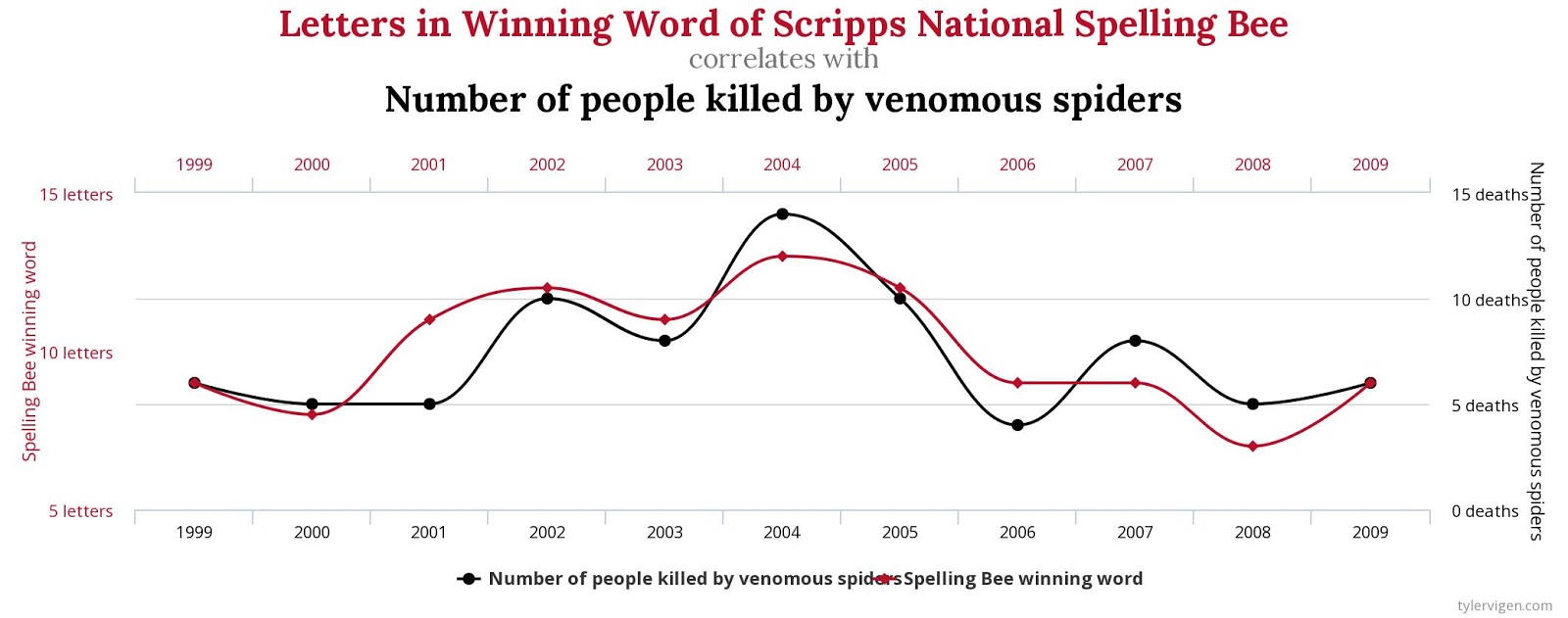
\”Pareidolia\” refers to the common human practice of looking at random outcomes but trying to impose patterns on them. For example, we all know in the logical part of our brain that there are a roughly a kajillion different variables in the world, and so if we look through the possibilities, we will will have a 100% chance of finding some variables that are highly correlated with each other. These correlations will be a matter of pure chance, and they carry no meaning. But when my own brain, and perhaps yours, sees one of these correlations, I can feel my thoughts start searching for a story to explain what looks to my eyes like a connected pattern. 

Here are some examples from Tyler Vigen\’s website, drawn from his 2015 book Spurious Correlations.

Eye-balling these kinds of figures gives you a sense of why these correlations arise. For example, if you have both a right-hand and a left-hand axis, you can set the scales on those figures so that draw the figure so that the starting points and the ending points of the two lines are close to each other–and then the intermediate lines will look fairly common as well.  If comparing to data on a certain statistic in a certain state (divorces in Maine, fishing accidents in Kentucky), your statistical antennae should be warning you that by the time you look through a large group of family or health statistics for each of 50 states, there\’s a reasonable chance of finding whatever pattern you are looking for just by random chance. If you limit the search to relatively short stretches of data like a decade or so, and plug in your computer to sort through the possibilities, finding meaningless correlations isn\’t going to be hard. 

Of course, at the more serious level of academic research, these types of issues can still arise. Imagine that a researcher is trying to look at the effects of a particular large-scale program. The researcher has lots of data to divide people up into groups: by age, work status, family status, geographic location, education, health, race/ethnicity, gender, religion, and more. The researcher also has lots of possible outcomes for these people: income, marriage or divorce, childbearing, health, employment, retirement, and others. If a researcher looks at all the possible subcategories, it will inevitably be true that this program will seem to have major effects in a certain group: for example, the program may be correlated with a big change in the divorce behavior of white people in the 35-54 age bracket with low levels of religious observance in the state of New York.  But if you (or your computer program) scanned through literally thousands of subgroups and possible effects to find this specific correlation, it\’s fair to assume that the correlation is just as meaningless as any of the examples presented by Vigen. 
Classes in statistics emphasize that \”correlation doesn\’t mean causation.\” The lesson here is even stronger. Correlation doesn\’t necessarily mean anything at all. 

How Economic Statistics Are Being Transformed

Economic statistics are invisible infrastructure, supporting better decisions by government, business, and individuals. But the fundamentals survey-based methods of US government statistics have substantially eroded, because people and firms have become less willing to fill out surveys in a timely and accurate way. There are active discussions underway about how to replace or supplement existing statistics with either administrative data from government programs or private-sector data. But these approaches have problems of their own.

For a big-picture overview of these issues, a useful starting point is the three-paper \”Symposium on the Provision of Public Data\” in the Winter 2019 issue of the Journal of Economic Perspectives

But if you want to get down and dirty with the details of what changes to government statistics are being researched and considered, you will want turn to the papers from the most recent Conference on Research in Income and Wealth, held March 16-17 in Washington, DC. The CRIW, which is administered by the National Bureau of Economic Research, has been holding conferences since 1939 with a mixture of researchers from government, academia, business, and nonprofits to talk about issues of economic measurement. Sixteen of the papers from the conference, most also including presentation slides, are available at the website.

In Winter 2019 JEP, Hughes-Cromwick and Coronado point out that the combined annual budget for the 13 major US government statistical agencies is a little over $2 billion. For comparison,  the “government-data–intensive sectors” a sector of the economy, which includes firms that rely heavily on government data like \”investment analysts, database aggregator firms, market researchers, benchmarkers, and others,\” now has annual revenues in the range of $300 billion or more. They also offer concrete examples how firms in just a few industries–automobiles, energy, and financial services–use government data as a basis for their own additional calculations for a very wide range of business decisions.

Rockoff points out that main government statistical series like inflation, unemployment, and GDP all emerged out of historical situations where it became important for politicians to have an idea of what was actually going on. For example, early US government efforts at measuring inflation emerged from the public controversy over the extent of price change in the Civil War and the early 1890s. Early measurement of GDP and national income emerged from disputes over the extent of inequality in the opening decades of the 20th century. Some of the earliest US unemployment statistics were collected in Massachusetts in the aftermath of the panic of 1873 and the depression that followed. As he points out, the ongoing development of these statistics was then shaped by changes in price, output, and unemployment during World Wars I and II, and the Great Depression.

This interaction between US government policy and statistics goes back to the origins of the US Census in 1790, when James Madison (then a member of the House of Representatives) argued that the Census should do more than just count heads, but should collect other economic data as well. In the Congressional debate, Madison said:

If gentlemen have any doubts with respect to its utility, I cannot satisfy them in a better manner, than by referring them to the debates which took place upon the bills, intend, collaterally, to benefit the agricultural, commercial, and manufacturing parts of the community. Did they not wish then to know the relative proportion of each, and the exact number of every division, in order that they might rest their arguments on facts, instead of assertions and conjectures?\”

In my own view, Madison\’s plaintive cry \”in order that they might rest their arguments on facts\” doesn\’t apply only or even mainly to Congress. Public economic statistics are a way for all citizens to keep tabs on their society and their government, too.

In JEP, Jarmin points out that survey-based methods of collecting government data have been seeing lower response rates. This pattern applies to the the main government surveys of households, including the Current Population Survey, the Survey of Income and Program Participation (SIPP), the Consumer Expenditure Survey, the National Health Interview Survey, and the General Social Survey. Similar concerns apply to surveys of businesses: the Monthly Retail Trade Survey, the Quarterly Services Survey, and the Current Establishment Survey. Surveys have the considerable advantage of being nationally representative, but they also have the disadvantage that you are relying on what people are telling you, rather than what actually happened. For example, if you compare actual payments from the food stamp program to what people report on surveys, you find that many people are receiving assistance from food stamps but not reporting it (or underreporting it) on the survey. Moreover, surveys are costly to carry out.

Can survey-based data be replaced by some combination of administrative data from government programs, private-sector data (which could perhaps be automatically submitted by firms), and \”big data\” automatically collected from websites? Sure up to a point.

For example, people\’s income and work can be examined by looking at income tax data and Social Security payroll data. A private company called NPD collects point-of-sale data directly from retailers; could the government tap into this data or perhaps contract with NPD to collect the data teh government desires, rather than doing its own separate survey on retail sales? Instead of collecting price data from stores for the measure of inflation, might it be possible to use automated data from price scanners in stores, or even scrape the data from websites that advertise prices for certain goods?

The papers presented at the CRIW conference talk about lots of specific proposals along these lines. Many are promising, and none are easy. For example, using administrative data from the IRS or Social Security raises concerns about privacy, and practical concerns about linking together data from very different computer systems. Is data collected by a private firm likely to be nationally representative? If the US government relies on a private firm for key data, how does the government make sure that the data isn\’t disclosed in advance, and what happens to the data if the firm doesn\’t perform well or goes out of business?

The idea of using data from barcodes to get a detailed view of sales and prices is definitely intriguing. But barcodes often change, which makes analyzing them complex to work with. As Ehrlich, Haltiwanger,  Jarmin,  Johnson,  and Shapiro point out in their paper for the CRIW conference:

Roughly speaking, if a good defined at the barcode or SKU level is sold today, there is only a fifty percent chance it will be sold a year from today. This turnover of goods is one of the greatest challenges of using the raw item-level data for measurement, but also is an enormous opportunity. When new goods replace old goods there is frequently both a change in price and quality. Appropriately identifying whether changing item-level prices imply changes in the cost of living or instead reflect changes in product quality is a core issue for measuring activity and inflation. The statistical agencies currently perform these judgments using a combination of direct comparisons of substitutes, adjustments, and hedonics that are very hard to scale.

Moreover, if government statistics are emerging from an array of different sources and evolving over time, how does one figure out whether changes in unemployment, inflation, and GDP are a result of actual changes in the economy, or just changes in how the variables are being measured? How does one balance the desire for accurate and detailed measurement, which often takes time, with a desire for continual immediate updates to the data?

Overall, it seems to me that one can discern a shadowy pattern emerging. There will be highly detailed and representative and costly government statistics published at longer intervals–maybe a year or five years or even 10 years apart. These will often rely on nationally-representative surveys. But In between, when it comes to smaller time intervals of single-month or three-month periods, the updates to these figures will rely more heavily on  extrapolations from the administrative and private sources that are available. We will know that these updates are not necessarily representative and subject to later corrections. The short-term updates may not always be fully transparent, because of concerns over privacy from both firms and individuals, but for the short-term, they will be a reasonable way to proceed.

The dream is that it becomes possible to develop better statistics with costs remaining the same or even lower. But for me, some additional investment in government statistics is an inexpensive way of supporting the decisions of firms and policymakers, and providing accountability to citizens.

Here\’s a list of the papers (and presentation slides) available at the conference website:

Why Call it "Socialism"?

I’ve been coming around to the belief that most modern arguments over “socialism” are a waste of time, because the content of the term has become so nebulous. When you drill down a bit, a lot of “socialists” are really just saying that they would like to have government play a more active role in providing various benefits to workers and the poor, along with additional environmental protection.

Here is some evidence on how Americans perceive “socialism” from a couple of Gallup polls, one published in May 2019 and one in October 2018. The May 2019 survey found that compared to 70 years ago, not long after World War II, both more American favor and oppose socialism–it’s the undecideds that have declined.

But when people say they are in favor of “socialism” or opposed to it, what do they mean? The same survey found that when asked a question about market vs. government, there were heavy majorities in favor of the free market being primarily responsible for technological innovation, distribution of weal, and the economy overall, and modest majorities in favor of the free market taking the lead in higher education and healthcare. Government leadership was preferred in taking the lead in online privacy and environmental protection.

There are apparently a reasonable number of those who think socialism is a good thing, but would prefer to see free markets be primarily responsible in many areas. Clearly, this form of socialism isn’t about government control of the means of production. The October 2018 Gallup survey asked more directly what people primarily meant by socialism, and compared the answer to a poll from the aftermath of World War II.

Seventy years ago, the most common answer for a person’s understanding of the term “socialism” was government economic control, but that answer has fallen from 34% to 17% over time. Now, the most common answer for one’s understanding of socialism is that it’s about “Equality – equal standing for everybody, all equal in rights, equal in distribution.” As the Gallup folks point out, this is a broad broad category: “The broad group of responses defining socialism as dealing with `equality’ are quite varied — ranging from views that socialism means controls on incomes and wealth, to a more general conception of equality of opportunity, or equal status as citizens.” The share of those who define “socialism” as “Benefits and services – social services free, medicine for all” has also risen substantially.  There are also 6% who think that “socialism” is “Talking to people, being social, social media, getting along with people.”

The October 2018  survey also asked whether the US already had socialism. Just after World War II, when the US economy had experienced extreme government control over the economy and most people defined “socialism” in those terms, 43% said that the US already had socialism. Now, the share of those who believe we already have socialism has dropped to 38%. One suspects that most of those who think we have socialism are not happy about it, and a substantial share of those who think we don’t have socialism wish it was otherwise. Clearly, they are operating from rather different visions of what is meant by “socialism.”

There’s no denying that the word “socialism” adds a little extra kick to many conversations.  Among the self-professed admirers, “socialism” is sometime pronounced with an air of defiance, as if the speaker was imagining Eugene Debs, five times the Socialist Party candidate for President, voting for himself from a jail cell in the 1920 election. In other cases, “socialism” is pronounced with an air of smiling devotion in the face of expected doubters, reminiscent of the very nice Jehovah’s Witnesses or Mormons who occasionally knock on my door. In still other cases, “socialism” is pronounced like a middle-schooler saying a naughty word, wondering or hoping that poking round with the term will push someone’s buttons, so we can mock them for being uncool. And “socialism” is sometimes tossed out with a world-weary tone, in a spirit of I-know-the-problems-but-what-can-I-say.

My own sense is that the terminology of “socialism” has become muddled enough that it’s not  useful in most arguments. For example, say that we’re talking about steps to improve the environment, or to increase government spending to help workers. One could, of course, could have an argument over whether the countries that have bragged most loudly about being “socialist” had a good record in protecting worker rights or the poor or the environment. One side could yelp about Sweden and the flaws that arise in a market-centric economy;  the other side could squawk about the Soviet Union or Venezuela and the flaws of a government-centric economy. (As I’ve argued in the past, I view the Scandinavian countries–and they view themselves–as a variation of capitalism rather than as socialism.)

While those conversations wander along well-trodden paths, they don\’t have much to say about–for example–how or if the earned income tax credit should be expanded, or the government should assist with job search, or if the minimum wage should rise in certain areas, or how a carbon tax would affect emissions, or how to increase productivity growth, or how to address the long-run fiscal problems of Social Security. Bringing emotion-laden and ill-defined terms like “socialism” into these kinds of specific policy conversations just derails them.

Thus, my modest proposal is that unless someone wants to advocate government ownership of the means of production, it’s more productive to drop “socialism” from the conversation. Instead, talk about the specific issue and the mixture of market and government actions rules that might address it, based on whatever evidence is available on costs and benefits.

Why Did the US Labor Share of Income Fall So Quickly?

The share of US national income going to labor was sagging through the second half of the century, but then plunged starting around 2000. The McKinsey Global Institute takes \”A new look at the declining labor share of income in the United States\” in a report by James Manyika, Jan Mischke, Jacques Bughin, Jonathan Woetzel, Mekala Krishnan, and Samuel Cudre (May 2019).

Here\’s a figure showing basic background. From 1947-2000, the labor share of income fell from 65.4% to 62.3%. There already seemed to be a pattern of decline in the 1980s and 1990s in particular, which was then reversed for a short time at the tail end of the dot-com boom. But since 2000, the labor share has sunk to 56.7% in 2016.

Why did this happen? The MGI analysis looks at 12 different sectors of the economy and how different possible explanations played out in these sectors. As they point out, these sectors all experienced a decline in labor share, but the sectors as a whole make up less than half of total US output, and tend to be \”more globalized, more digitized, and more capital-intensive than the overall economy.\” Thus, factors that might affect the labor share like globalization, growth of the digital economy, and substituting capital for labor are likely to play a bigger role in these sectors than in the rest of the economy.

 But here\’s their ranking of five main causes for the decline in labor\’s share of income:

We find that that the main drivers for the decline in the labor share of income since 1999 are as follows, starting with the most important: supercycles and boom-bust (33 percent), rising depreciation and shift to IPP capital (26 percent), superstar effects and consolidation (18 percent), capital substitution and technology (12 percent), and globalization and labor bargaining power (11 percent)

The list is intriguing and a little surprising, because some of the factors most commonly discussed as potential causes of the decline in labor share–globalization, capital substituting for labor, and \”superstar\” firms emerging from industry consolidation–play a relatively smaller role. One possible interpretation is that sharp drop in labor income from 1999-2016 was a little deceptive, because in part it was based on cyclical factors, but a number of the factors underlying a longer-term decline in labor share continue to operate.

On the topic of supercycles and boom-bust, the MGI report says:

\”Even after adjusting for depreciation, we estimate that supercycles and boom-bust effects—particularly in extractive industries and real estate—account for one-third of the surge in gross capital share since the turn of the millennium. In two sectors, mining and quarrying and coke and refined petroleum, capital share increases were led by increased returns on invested capital and higher profit margins during a sharp and prolonged rise in prices of metals, fuels, and other commodities fed by China’s economic expansion in the 2000s. … Housing-related industries also contributed. The capital-intensive real estate sector grew in importance in terms of gross value added during the bubble, leading to a substantial mix effect raising the capital share of income.\”

On the topic of rising depreciation and shift to intangible capital, they write: 

Higher depreciation is the second-largest contributor to the increase in gross capital share, accounting for roughly one-fourth  (26 percent) of the total. Depreciation matters for labor share analyses, because the  baseline, GDP, is a “gross” metric before depreciation; if more capital is consumed during the production process, there is less net margin to be distributed to labor or capital. This fact, which receives little attention in the literature, is particularly visible in manufacturing, the public sector, primary industries, and infrastructure services. One reason depreciation has become such a large factor in driving up the capital share is the increase in the share of intellectual property products capital—software, databases, and research and development—which depreciates faster than traditional capital investments such as buildings. The increase has been substantial: the share of IPP capital rose from 5.5 percent of total net capital stock for the total economy in 1998 to 7.3 percent in 2016, an increase of almost 33 percent.

On the topic of  superstar effects and consolidation: 

We estimate that superstar effects contribute about one-fifth of the capital share increase. We base this estimate on analyzing which industries actually saw an increase in ROIC [return on investment capital] as a direct driver of capital share increases and where the increase goes hand-in-hand with (and may partially result from) rising consolidation or rise of superstar firms. Such patterns seemed particularly pronounced in several industries, and for each of them, superstar effects were marked as a “highly relevant” or “relevant” driver. Telecommunications, media, and broadcasting, for instance, experienced significant rises in returns. The transportation and storage industry went through another round of  airline consolidation and recovered from the crisis to ROIC levels that are high by historical standards. The pharmaceutical and chemicals as well as information and computer services sectors are also known for superstar effects. Finally, wholesale and retail as well as refining also went through a spurt in returns and consolidation. 

On the topic of capital substitution and technology:

The fourth-most important factor driving the increase in capital share of income appears to relate to a substitution of capital for labor, through factors including decreasing technology prices and better capabilities of machines. We estimate that this effect accounts for 12 percent of the increase in capital share in the industries we analyzed. 

On the topic of globalization and labor bargaining power:

One of the most discussed reasons for labor’s declining share of income—the weakening of labor bargaining power under pressure from globalization—is, in our analysis, not as important as other factors for the total economy in the time frame we focus on. It explains 11 percent of the overall decline. … Globalization and labor bargaining power did have a very large and visible impact in a few of our selected sectors. A prime example is automobile manufacturing, where declining union coverage and falling wages as production shifted to the southern United States and Mexico increased the capital share. … To a lesser extent, the computer and electronics sector, which contributed 9 percent to the total increase in capital share, was also affected by growing globalization of supply chains and offshoring, although other factors played an important role for this sector. Finally, the numerous remaining smaller manufacturing industries not among the 12 sectors we extensively analyze have probably been affected by globalization, and more specifically by the rise of China as a major trade hub since its accession to the World Trade Organization in 2001.

You can read the report for the sector-by-sector analysis, and consider how the factors might affect the sectors of the economy outside the focus of this report. But again, because the sector on which they focus are \”more globalized, more digitized, and more capital-intensive than the overall economy,\” globalization, growth of the digital economy, and substituting capital for labor are less likely to be major factors in the rest of the economy than in these sectors.